Complete Guide to Healthcare Across Europe: How Do European Healthcare Systems Work?
Healthcare is one of the most important pillars of modern European society. Across the continent, countries have developed healthcare systems designed to provide medical treatment, preventive care, emergency services, and long-term health support to their populations. However, European healthcare is not based on one universal model. Each country has its own approach to healthcare financing, insurance coverage, hospital management, medical professionals, and patient services.
From publicly funded healthcare in the United Kingdom and Spain to social health insurance models in Germany and France, European countries demonstrate different ways of organising medical services. Some systems rely primarily on government funding, while others combine compulsory insurance contributions with public subsidies and private healthcare providers.
But how do European healthcare systems actually work? Who pays for medical treatment? Is healthcare free in Europe? Can international visitors access European hospitals? And which countries offer the most accessible healthcare services?
Understanding these questions helps explain why Europe is widely recognised for its diverse healthcare approaches and commitment to public health. Let’s explore how healthcare systems operate across Europe, what makes them different, and how they support millions of people every year.
1. What Are European Healthcare Systems?
European healthcare systems refer to the different structures through which European countries organise, finance, and deliver medical services to their populations. These systems include hospitals, general practitioners, specialist doctors, pharmacies, emergency departments, rehabilitation centres, and preventive healthcare programmes.
Although individual countries follow different healthcare policies, many share similar objectives: providing accessible medical treatment, protecting people from excessive healthcare costs, improving public health, and ensuring that patients receive appropriate medical attention.
Most European healthcare systems operate through a combination of public funding, compulsory health insurance, private insurance, and direct patient payments.
Their main objectives include:
- Providing essential medical services to residents.
- Making healthcare financially accessible.
- Supporting preventive healthcare and early diagnosis.
- Ensuring access to emergency medical treatment.
- Improving maternal and child healthcare.
- Supporting elderly people and patients with chronic conditions.
- Maintaining medical standards and patient safety.
The European healthcare landscape is therefore a combination of national healthcare policies rather than a single continent-wide system.
2. How Do European Healthcare Systems Work?
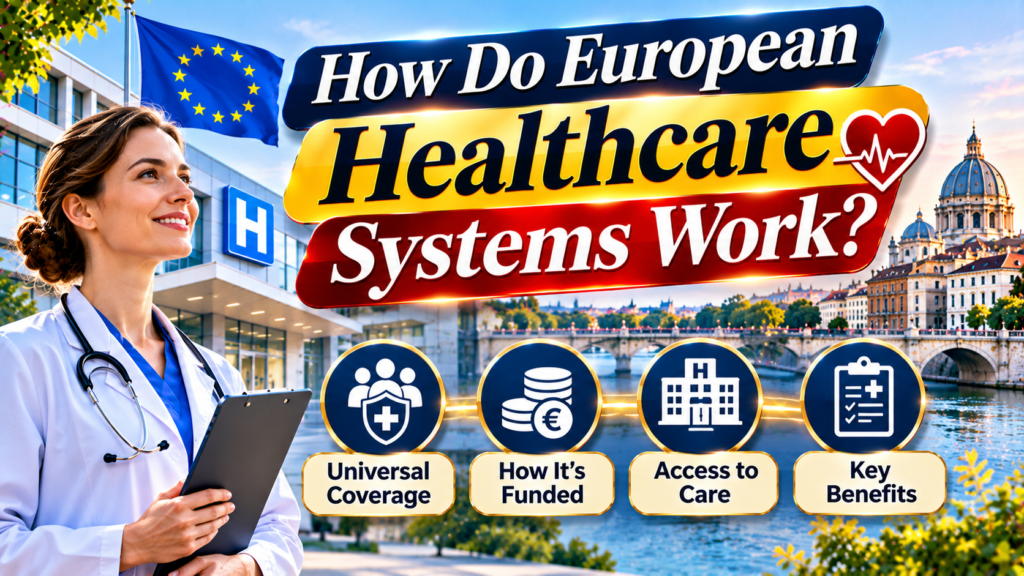
European healthcare systems generally work by collecting money through taxation, compulsory health insurance contributions, or a combination of both. Governments and insurance organisations use these funds to pay for medical services provided by hospitals, clinics, doctors, and other healthcare professionals.
The exact process depends on the country.
In tax-funded systems, governments collect money through general taxation and allocate a portion of public spending to healthcare. Eligible residents can access covered medical services through publicly funded facilities and contracted healthcare providers.
In insurance-based systems, employees, employers, self-employed individuals, and sometimes the government contribute to health insurance schemes. Insurance organisations then reimburse healthcare providers for eligible treatments.
For example, Germany operates a social health insurance model in which most residents are covered through statutory health insurance. The United Kingdom, meanwhile, relies primarily on general taxation to fund its National Health Service (NHS).
A typical healthcare process in Europe involves:
- Registration: Residents register with a healthcare provider or insurance organisation, depending on national rules.
- Primary consultation: Patients usually contact a general practitioner (GP) or primary care centre for initial medical advice.
- Diagnosis: Doctors assess symptoms and recommend tests, medication, or specialist consultations.
- Specialist treatment: Patients receive additional care when referred or when direct specialist access is permitted.
- Hospital services: More complex medical conditions are treated in hospitals or specialised healthcare facilities.
- Follow-up care: Patients receive rehabilitation, prescriptions, monitoring, or further consultations when necessary.
This structure helps coordinate medical treatment while managing healthcare resources.
3. Is Healthcare Free in European Countries?
One of the most common questions about European healthcare is whether medical treatment is free.
The answer is that healthcare is not entirely free in every European country. However, many countries provide publicly funded or heavily subsidised medical services that reduce the amount patients pay when receiving treatment.
In countries with tax-funded healthcare systems, eligible residents can access many essential services without paying directly at the point of treatment. Nevertheless, certain services may involve prescription charges, dental fees, private treatment costs, or other contributions.
In insurance-based systems, patients generally receive healthcare coverage through statutory or compulsory insurance. Depending on the country and treatment, they may need to pay deductibles, co-payments, or additional fees.
Examples include:
- United Kingdom: NHS services are largely funded through taxation, with many hospital and GP services free at the point of use for eligible residents.
- Spain: Public healthcare provides extensive medical coverage for eligible residents through taxation and public funding.
- France: Healthcare is largely organised through statutory health insurance, with reimbursement for many medical services.
- Germany: Statutory health insurance covers most residents, with certain co-payments applying to specific services.
- Italy: The National Health Service provides a broad range of publicly funded medical services, although regional differences and patient charges exist.
Therefore, the idea of free healthcare in Europe is better understood as publicly funded or subsidised access rather than completely cost-free treatment for every medical service.
4. What Are the Main Types of Healthcare Systems in Europe?
European countries use several healthcare financing models. These models reflect differences in economic policies, taxation systems, social security arrangements, and national healthcare priorities.
A. Tax-Funded Healthcare Systems
Tax-funded healthcare systems receive most of their financial resources from general government taxation.
The government collects taxes from individuals and businesses and allocates part of the revenue to public healthcare services. Hospitals, clinics, and healthcare professionals receive funding through public budgets or government contracts.
The United Kingdom is one of the best-known examples of this approach.
Advantages include:
- Broad access to essential healthcare services.
- Reduced financial barriers at the point of treatment.
- Government oversight of healthcare funding.
- Strong emphasis on public health and preventive care.
However, these systems may experience long waiting times for certain specialist consultations and non-emergency procedures.
B. Social Health Insurance Systems
Social health insurance systems rely on compulsory contributions from employees, employers, and other eligible groups.
These contributions are collected through insurance funds or statutory health insurance organisations. The funds are then used to reimburse healthcare providers and cover eligible medical treatments.
Germany, France, Belgium, and Austria are examples of countries with significant social health insurance arrangements, although their systems differ in important ways.
Major characteristics include:
- Mandatory or broadly compulsory health insurance.
- Contributions linked to income or employment.
- Coverage for eligible family members under certain conditions.
- Public regulation of insurance organisations.
- Access to networks of hospitals and medical professionals.
These systems aim to distribute healthcare costs across the population.
C. Mixed Healthcare Systems
Some European countries combine public healthcare funding, compulsory insurance, and private healthcare services.
In these systems, government-funded medical services operate alongside private hospitals, clinics, and insurance providers.
Patients may use public services for essential treatment while choosing private healthcare for additional convenience, specialist access, or services not fully covered by public arrangements.
Mixed healthcare models offer flexibility but can create differences in waiting times, costs, and access to treatment.
5. How Does Public Healthcare Work in Europe?
Public healthcare plays a central role in many European countries. It is designed to ensure that eligible residents can access essential medical services regardless of their income or financial circumstances.
Public healthcare systems are usually financed through taxation, social insurance contributions, or both.
Governments establish healthcare policies, regulate medical services, supervise public hospitals, and determine which treatments receive public funding.
Public healthcare commonly includes:
- General medical consultations.
- Emergency treatment.
- Hospital admissions.
- Surgery and specialist treatment.
- Maternity and childbirth services.
- Vaccination programmes.
- Preventive health screenings.
- Treatment for chronic diseases.
- Mental health support, depending on national coverage.
The availability and cost of these services vary between countries.
For example, public hospitals in Spain and Italy operate under national health service frameworks, while Germany relies more heavily on statutory insurance arrangements to finance healthcare providers.
Public healthcare is particularly important for people who require regular medical treatment, elderly residents, children, and individuals with long-term health conditions.
6. What Role Does Private Healthcare Play in Europe?
Private healthcare is another important part of the European medical landscape. Although public healthcare provides extensive services in many countries, private hospitals, clinics, laboratories, and medical specialists also operate throughout the continent.
Private healthcare is often chosen by people who want additional treatment options, greater flexibility, or access to certain specialists without using public healthcare pathways.
Some patients also purchase private health insurance to cover services that may not be fully included in their public or statutory health insurance arrangements.
Common private healthcare services include:
- Private hospital consultations.
- Specialist medical appointments.
- Dental treatment.
- Diagnostic testing.
- Elective procedures.
- Physiotherapy and rehabilitation.
- Certain cosmetic and wellness treatments.
Private healthcare can offer shorter waiting times for some services, but it is generally more expensive.
Importantly, private healthcare does not necessarily mean better medical quality. Public hospitals across Europe also provide advanced treatment, highly trained professionals, and sophisticated medical technology.
7. How Do European Countries Fund Their Healthcare Systems?
Healthcare funding is essential for maintaining hospitals, employing doctors, purchasing medical equipment, developing medicines, and supporting public health programmes.
European countries use different funding arrangements, depending on their healthcare models.
The main sources of healthcare financing include:
1. General taxation
Governments allocate revenue from income taxes, corporate taxes, consumption taxes, and other sources to public healthcare services.
2. Employer contributions
In several European countries, employers contribute to compulsory health insurance schemes on behalf of their employees.
3. Employee contributions
Workers may pay a portion of their income towards statutory health insurance or social security programmes.
4. Government subsidies
Governments provide additional financial assistance to support healthcare coverage for children, unemployed people, low-income households, and other eligible groups.
5. Private health insurance
Individuals and employers may purchase supplementary or alternative private health insurance policies.
6. Out-of-pocket payments
Patients sometimes pay directly for prescriptions, dental treatment, private consultations, and services that are not fully covered.
The combination of these funding sources helps European countries maintain their healthcare infrastructure and provide medical services to millions of people.
8. How Does Primary Healthcare Work in Europe?
Primary healthcare is generally the first point of contact between patients and the medical system. It focuses on everyday medical needs, early diagnosis, disease prevention, and long-term health management.
General practitioners play a particularly important role in countries such as the United Kingdom, Denmark, the Netherlands, and Germany.
Patients commonly visit a GP when they experience symptoms such as fever, infections, digestive problems, minor injuries, or other non-emergency medical concerns.
Primary healthcare professionals may also provide:
- Routine health examinations.
- Vaccinations.
- Blood pressure monitoring.
- Diabetes management.
- Preventive health advice.
- Medication prescriptions.
- Referrals to specialists.
- Follow-up care for chronic conditions.
In several European countries, patients are expected to consult their GP before receiving treatment from certain hospital specialists. This referral system helps coordinate medical services and manage demand.
However, referral requirements are not universal. Some healthcare systems allow patients to contact specialists directly, depending on their insurance arrangements and national rules.
9. How Do Hospitals and Emergency Services Operate in Europe?
Hospitals are among the most important components of European healthcare systems. They provide services ranging from routine medical treatment to complex surgeries, intensive care, cancer treatment, and emergency medicine.
European hospitals may be publicly owned, privately operated, or run by non-profit organisations.
Public hospitals generally receive funding through government budgets, statutory insurance reimbursements, or a combination of these arrangements.
Emergency healthcare services are designed to respond to serious medical situations such as road accidents, heart attacks, strokes, severe injuries, and life-threatening illnesses.
Important emergency services include:
- Emergency departments.
- Ambulance services.
- Intensive care units.
- Emergency surgery.
- Trauma centres.
- Specialised cardiac and stroke units.
The European Union’s common emergency telephone number is 112, which can be used to contact emergency services across EU member states.
However, the organisation and financing of emergency services differ between countries.
European countries also invest in specialised hospitals and advanced medical facilities to provide treatment for complex conditions.
10. How Does Health Insurance Work in European Countries?
Health insurance is a major part of healthcare financing across Europe. Depending on the country, residents may be covered through national health services, compulsory statutory insurance, private insurance, or a combination of these arrangements.
In insurance-based systems, individuals generally pay regular contributions to maintain healthcare coverage.
The insurance organisation then pays healthcare providers for covered services, either directly or through reimbursement arrangements.
Health insurance policies may cover:
- GP consultations.
- Specialist medical treatment.
- Hospital admissions.
- Surgery.
- Prescription medicines.
- Maternity care.
- Diagnostic tests.
- Rehabilitation services.
However, coverage differs between national schemes and individual insurance policies.
Some countries also provide supplementary private insurance to help cover additional medical expenses.
For example, France has a well-established supplementary insurance market, while Germany offers statutory and private health insurance options under specific eligibility conditions.
Understanding local insurance requirements is particularly important for international workers, students, expatriates, and people relocating to Europe.
11. Which European Countries Have Different Healthcare Models?
Although European countries share many healthcare objectives, their systems differ in how they finance and organize medical services.
Here are some important examples.
United Kingdom: How Does the NHS Work?
The United Kingdom operates the National Health Service (NHS), one of the world’s best-known publicly funded healthcare systems.
The NHS is primarily financed through general taxation and provides a wide range of medical services to eligible residents.
Patients can generally access GP consultations, hospital treatment, emergency services, and other essential healthcare without direct charges at the point of use, although prescription, dental, and other charges may apply.
The NHS operates across England, Scotland, Wales, and Northern Ireland, with different administrative structures and healthcare policies in each nation.
Germany: How Does the Health Insurance System Work?
Germany uses a social health insurance model supported by statutory and private health insurance arrangements.
Most residents are covered through statutory health insurance, which is financed mainly by income-related contributions from employees and employers.
The system provides access to doctors, hospitals, specialists, medicines, and preventive medical services.
Germany is also known for its extensive hospital infrastructure and large network of healthcare professionals.
France: How Does the French Healthcare System Work?
France operates a statutory health insurance system that reimburses a significant proportion of eligible medical expenses.
The system is funded through social contributions and taxation.
Patients can access GPs, specialists, hospitals, and diagnostic services. Supplementary private insurance, commonly known as mutuelle, often helps cover expenses that are not fully reimbursed by statutory insurance.
Spain: How Does Public Healthcare Work?
Spain has a tax-funded National Health System known as the Sistema Nacional de Salud.
It provides extensive healthcare coverage to eligible residents through public hospitals, primary healthcare centres, and specialist facilities.
Healthcare responsibilities are shared between the national government and Spain’s autonomous communities.
This decentralised structure allows regional governments to manage many healthcare services, although it can also create regional differences in service delivery.
Italy: How Does the National Health Service Operate?
Italy operates the Servizio Sanitario Nazionale (SSN), a public healthcare system largely funded through taxation.
The system provides access to essential medical services, including GP consultations, hospital treatment, specialist care, and preventive healthcare.
Regional authorities play a major role in organising healthcare delivery.
As a result, waiting times, healthcare resources, and service availability can vary across different Italian regions.
Sweden: How Does the Swedish Healthcare System Work?
Sweden has a predominantly tax-funded healthcare system that is managed through national, regional, and local government responsibilities.
Regional authorities are primarily responsible for organising healthcare services, while municipalities provide certain forms of healthcare and elderly care.
Patients generally pay regulated fees for many services, although annual cost protections help limit certain healthcare expenses.
Sweden places considerable emphasis on preventive care, digital health services, and equal access to medical treatment.
12. How Does Europe Provide Healthcare for International Visitors?
Europe welcomes millions of international tourists, business travellers, students, and temporary workers every year. However, healthcare access for visitors depends on their nationality, residency status, insurance arrangements, and destination country.
Citizens and eligible residents of European Union countries can use the European Health Insurance Card (EHIC) when temporarily visiting another EU country.
The card provides access to medically necessary state-provided healthcare during a temporary stay under the same conditions and at the same cost as people insured in the country being visited.
However, EHIC does not replace travel insurance.
It generally does not cover private healthcare, planned medical treatment abroad, or costs such as repatriation.
Visitors from outside the European Union, including tourists from India and other Asian countries, should consider purchasing suitable travel medical insurance before travelling.
International visitors should understand that:
- Emergency treatment may be available regardless of insurance status.
- Non-emergency treatment may involve significant costs.
- Private medical facilities may require advance payment.
- Travel insurance can help cover unexpected medical expenses.
- Visa and residency requirements may include health insurance conditions.
Planning ahead can prevent unexpected medical and financial difficulties during international travel.
13. What Role Does Technology Play in European Healthcare?
Technology is transforming how healthcare services are delivered across Europe. Hospitals, clinics, doctors, and healthcare organisations increasingly use digital tools to improve patient communication, medical diagnosis, treatment coordination, and healthcare administration.
Digital healthcare initiatives aim to make medical services more accessible, efficient, and connected.
Important developments include:
Electronic health records: Digital records allow authorised healthcare professionals to access relevant patient information and support continuity of care.
Telemedicine: Patients can consult doctors remotely through video calls and digital platforms.
Artificial intelligence: AI-based tools can assist medical professionals with medical imaging, data analysis, and certain diagnostic tasks.
Digital prescriptions: Electronic prescriptions help patients and pharmacies manage medication more efficiently.
Remote patient monitoring: Connected medical devices can help monitor conditions such as diabetes, heart disease, and high blood pressure.
Health data sharing: European initiatives are working towards improving secure access to health information across healthcare systems.
The European Health Data Space is an important EU initiative intended to improve access to and exchange of electronic health data while establishing safeguards for privacy and security.
Although digital healthcare adoption varies between countries, technology is becoming an increasingly important part of Europe’s medical infrastructure.
14. How Do European Healthcare Systems Support Preventive Medicine?
Preventive healthcare is an essential part of Europe’s approach to improving population health.
Rather than focusing exclusively on treating illnesses after they develop, healthcare authorities encourage early detection, healthy lifestyles, vaccination, and regular medical examinations.
Preventive healthcare programmes help reduce the risk of serious diseases and support healthier communities.
Common preventive healthcare initiatives include:
- Childhood vaccination programmes.
- Cancer screening.
- Cardiovascular health assessments.
- Diabetes prevention and monitoring.
- Maternal and reproductive healthcare.
- Smoking cessation programmes.
- Nutrition and physical activity campaigns.
- Public awareness initiatives.
Many European countries also promote workplace health programmes and community-based health services.
Preventive medicine can reduce the long-term burden on hospitals by identifying potential health problems earlier and encouraging people to seek medical advice when necessary.
15. What Are the Biggest Challenges Facing European Healthcare Systems?
Despite significant achievements, European healthcare systems face several challenges. Population ageing, rising medical costs, staff shortages, technological changes, and increasing demand for treatment are placing pressure on healthcare providers.
Understanding these challenges is important when evaluating the future of European healthcare.
Ageing Population
Europe has an ageing population, increasing demand for services such as elderly care, rehabilitation, chronic disease management, and long-term medical support.
Healthcare Worker Shortages
Many countries face shortages of doctors, nurses, specialist professionals, and other healthcare workers. These shortages can affect hospital capacity and patient waiting times.
Rising Healthcare Costs
Advanced medical technology, expensive medicines, new treatments, and an increasing demand for healthcare services contribute to rising expenditure.
Waiting Times
Some public healthcare systems experience delays for specialist appointments, diagnostic procedures, and non-emergency operations.
Regional Inequalities
Healthcare availability can differ between major cities, smaller towns, rural communities, and remote regions.
Mental Healthcare Demand
Mental health services are receiving greater attention, but access to psychologists, psychiatrists, and counselling services remains uneven across countries.
Digital Transformation
Healthcare providers must invest in digital infrastructure while ensuring patient privacy, cybersecurity, and reliable access to medical information.
Addressing these issues will require continued investment, effective healthcare planning, and cooperation between governments and medical organisations.
16. Are European Healthcare Systems Better Than Private Healthcare Systems?
Comparing public and private healthcare systems is not always straightforward because both have different purposes and strengths.
Public healthcare systems generally focus on providing broad access to essential medical treatment while protecting people from excessive healthcare expenses.
Private healthcare often offers additional choices, flexibility, and potentially shorter waiting times for certain procedures.
However, the quality of medical care depends on several factors, including hospital standards, medical professionals, equipment, patient safety, and treatment outcomes.
Public healthcare advantages:
- Broad coverage for eligible residents.
- Reduced financial barriers.
- Strong public health programmes.
- Government regulation and oversight.
- Support for vulnerable populations.
Private healthcare advantages:
- Additional treatment options.
- Greater flexibility in choosing providers.
- Potentially shorter waiting times for certain services.
- Access to supplementary medical facilities.
Many European countries combine public and private healthcare to provide different treatment options.
Rather than viewing the two approaches as competitors, it is useful to understand how they can complement each other.
17. What Is the Future of Healthcare Systems in Europe?
The future of European healthcare will likely be shaped by digital innovation, medical research, preventive medicine, demographic changes, and stronger international cooperation.
European governments are increasingly focusing on building healthcare systems that are more resilient, accessible, and capable of responding to emerging health challenges.
Several developments are expected to influence the coming years.
1. Expansion of digital healthcare: Telemedicine, electronic medical records, and remote monitoring are likely to become more widely integrated into healthcare services.
2. Greater use of artificial intelligence: AI may support medical imaging, clinical decision-making, hospital administration, and personalised treatment planning.
3. Personalised medicine: Advances in genetics and medical research could help doctors develop treatments based on individual patient characteristics.
4. Stronger preventive healthcare: Governments are likely to place greater emphasis on early diagnosis, vaccination, and healthy lifestyle initiatives.
5. Investment in healthcare professionals: Training, recruitment, and improved working conditions will remain important for addressing staff shortages.
6. Better cross-border cooperation: European countries will continue working towards improving medical research, health data exchange, and access to healthcare across borders.
7. Sustainable hospitals: Healthcare organisations are increasingly considering energy efficiency, environmentally responsible operations, and sustainable medical infrastructure.
These developments could help European countries build more adaptable healthcare systems capable of meeting future medical needs.
18. Why Are European Healthcare Systems Important for Global Healthcare?
European healthcare systems provide valuable examples of how countries can organise medical services, finance healthcare, and promote public health.
Their different approaches offer useful lessons for governments and policymakers around the world.
Countries can learn from Europe’s experience in areas such as universal healthcare coverage, social insurance, preventive medicine, patient protection, medical education, and digital health development.
The European healthcare landscape also demonstrates that there is no single solution suitable for every country. National income levels, population size, demographics, healthcare infrastructure, and government policies all influence how healthcare systems operate.
For developing countries, European experiences can provide insights into expanding medical coverage, strengthening primary healthcare, improving hospital infrastructure, and reducing financial barriers to treatment.
Ultimately, the success of a healthcare system depends not only on its funding model but also on how effectively it delivers safe, affordable, and accessible medical services.
Conclusion: How Do European Healthcare Systems Work?
European healthcare systems operate through a variety of public funding, social insurance, and private healthcare arrangements. Although each country has its own policies and administrative structure, many share the goal of ensuring that residents can access essential medical services without facing excessive financial hardship.
From the NHS in the United Kingdom to Germany’s statutory health insurance system and Spain’s tax-funded National Health System, Europe demonstrates different approaches to organising and financing healthcare.
Public hospitals, private clinics, primary healthcare centres, insurance organisations, and digital medical services all contribute to the continent’s healthcare infrastructure.
However, challenges such as ageing populations, staff shortages, rising medical costs, and unequal access remain important concerns.
As technology advances and healthcare needs evolve, European countries will continue adapting their systems to improve medical services and protect public health.
Understanding how European healthcare systems work offers valuable insight into the relationship between government policies, medical innovation, healthcare funding, and the wellbeing of society.
Read More – What Are the Most Famous Traditional Breakfast in Europe?