
Ultimate Guide To Know What Are the Biggest Challenges Facing European Democracy?
European democracy is widely recognised as one of the foundations of modern European society. It is built on principles such as freedom of expression, equality, human rights, political participation, independent institutions and the rule of law. Across Europe, democratic systems allow citizens to elect their representatives, express their opinions, participate in public debates and hold governments accountable for their decisions. These values have played an important role in shaping European political institutions, strengthening international cooperation and protecting individual freedoms.
However, European democracy faces several significant challenges in the modern world. Political polarization, the rise of populist movements, misinformation, declining public trust, economic inequality, foreign interference and growing social divisions are putting pressure on democratic institutions. Rapid technological changes and geopolitical tensions have also created new difficulties for governments and citizens.
Although European countries have different political systems, histories and social conditions, many of them face similar democratic concerns. Understanding these challenges is essential for protecting democratic values and ensuring that future generations continue to enjoy political freedom, equality and justice.
So, what are the biggest challenges facing European democracy? Why are democratic institutions under pressure, and what can European governments and citizens do to protect democracy? Let’s explore the major issues shaping the future of democracy across Europe.
1. What Is European Democracy and Why Is It Important?
European democracy refers to the political systems and democratic principles that allow people across European countries to participate in government and influence public decisions. Although each country has its own constitution, electoral arrangements and political traditions, democratic governance generally depends on free and fair elections, political accountability, individual rights and the rule of law.
The European Union also promotes democratic principles through its institutions and legal framework. Democracy, human dignity, freedom, equality and respect for human rights are among the fundamental values on which the EU is founded.
European democracy is important because it gives citizens the opportunity to shape their societies. People can vote for political representatives, criticize government policies, join political organizations and participate in peaceful protests.
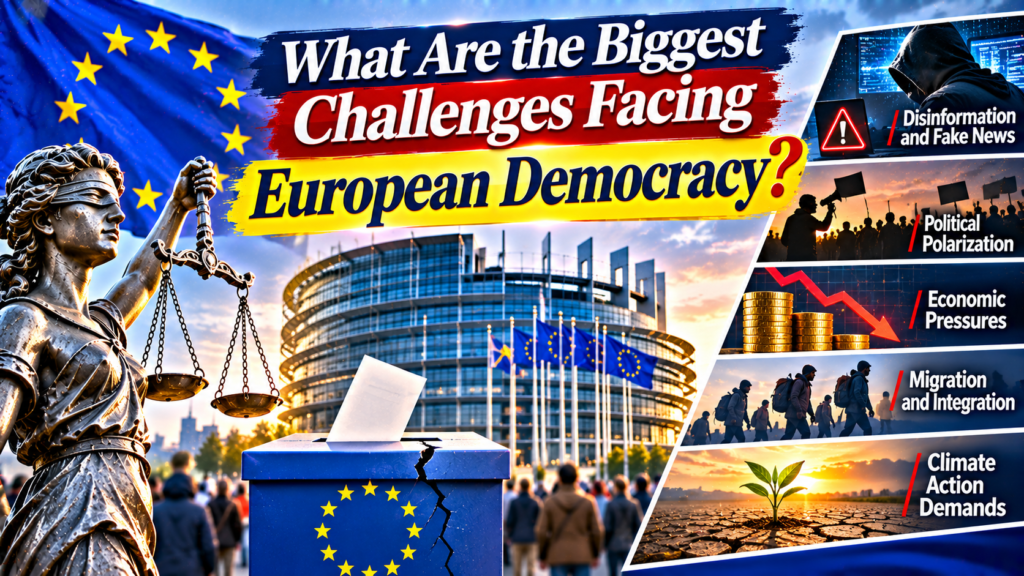
Some of the most important principles of European democracy include:
- Free and fair elections: Citizens have the right to choose their political representatives through transparent elections.
- Freedom of expression: Individuals can share opinions, question government decisions and participate in public discussions.
- Equality before the law: Every individual should receive equal legal protection regardless of their background.
- Independent judiciary: Courts must operate without inappropriate political interference.
- Protection of minority rights: Democratic governments must protect the rights and freedoms of minority communities.
- Government accountability: Elected leaders must remain answerable to citizens and democratic institutions.
Despite these European democracy principles, maintaining a healthy democratic system requires continuous effort. Political, economic and technological developments can weaken democratic institutions if they are not addressed effectively.
2. Why Is Political Polarisation a Major Challenge for European Democracy?
Political polarisation is one of the biggest challenges facing European democracy. It occurs when society becomes increasingly divided into opposing political groups with different ideologies, values and expectations.
Across several European countries, political debates have become more confrontational. Differences over immigration, national identity, economic policies, climate change, European integration and social issues have created strong divisions among voters.
Political disagreements are normal in a European democracy. However, polarization becomes dangerous when political opponents are treated as enemies rather than people with different opinions.
Growing political polarisation can create several problems:
- It makes cooperation between political parties more difficult.
- It encourages extreme political positions.
- It reduces public confidence in democratic institutions.
- It creates divisions between different social and cultural groups.
- It makes constructive political discussions increasingly difficult.
Social media platforms can intensify these divisions by promoting emotionally charged political content. People may increasingly interact with information that supports their existing beliefs while avoiding opposing viewpoints.
To address political polarisation, European governments and political leaders need to encourage respectful public discussions, strengthen civic education and promote political cooperation.
3. How Is the Rise of Populism Affecting European Democracy?
The growth of populist political movements is another important challenge for European democracy. Populism generally presents politics as a struggle between ordinary people and an established political elite. Populist leaders often claim to represent the interests of citizens who feel ignored by traditional political parties.
Populist movements have gained attention in different European countries by addressing public concerns about immigration, unemployment, economic insecurity, national sovereignty and political accountability.
Populism is not automatically incompatible with democracy. Movements that challenge established political parties can bring neglected public concerns into political discussions. However, problems arise when populist leaders weaken independent institutions, attack democratic checks and balances or question the legitimacy of political opposition.
Some democratic risks associated with extreme populist politics include:
- Weakening the independence of courts and other institutions.
- Undermining trust in independent journalism.
- Promoting hostility towards minority communities.
- Presenting political opponents as enemies of the nation.
- Concentrating political power in the hands of individual leaders.
The challenge for European democracy is to address the legitimate concerns of voters while protecting constitutional principles, institutional independence and political pluralism.
4. Why Is Declining Public Trust in Political Institutions a Serious Concern?
Public trust is essential for the successful functioning of European democracy. Citizens need confidence that governments, parliaments, courts, political parties and public institutions work in the public interest.
However, trust in political institutions has become a concern in several European societies. Some citizens feel that political leaders do not understand their everyday problems or deliver on their election promises.
Issues such as corruption scandals, political controversies, slow decision-making and economic difficulties can further weaken public confidence.
When people lose trust in democratic institutions, they may become less interested in elections, political discussions and civic participation.
Several factors contribute to declining political trust:
- Unfulfilled election promises.
- Perceptions of corruption and political favouritism.
- Lack of transparency in government decisions.
- Poor communication between political leaders and citizens.
- Concerns about unequal treatment and political accountability.
- Limited opportunities for ordinary people to influence public policy.
Rebuilding trust requires transparent government operations, effective public services, stronger anti-corruption measures and meaningful communication between citizens and elected representatives.
5. How Does Misinformation Threaten European Democracy?
Misinformation and disinformation are serious challenges for modern democratic societies. Misinformation refers to false or inaccurate information shared without necessarily intending to deceive, while disinformation involves deliberately spreading misleading information to influence public opinion.
Digital platforms have made it easier for information to travel across national borders within seconds. Although this has improved access to news and political discussions, it has also increased the spread of misleading content.
False political claims, manipulated photographs, misleading videos and fabricated news stories can influence public perceptions of elections, government policies and international events.
Misinformation can damage European democracy in several ways:
- Influencing elections: False information can mislead voters about candidates, political parties and election procedures.
- Creating public confusion: Misleading reports can make it difficult for citizens to distinguish facts from opinions.
- Increasing social divisions: False narratives can create hostility between political, ethnic and cultural communities.
- Weakening journalism: Unverified information can reduce public confidence in credible news organisations.
- Undermining institutions: Coordinated misinformation campaigns can damage trust in democratic institutions.
European governments, media organisations and technology companies must work together to improve digital literacy, support independent journalism and encourage responsible online communication.
6. Why Is Foreign Interference a Growing Threat to European Democracy?
Foreign interference has become an important concern for European democratic institutions. External governments or organisations may attempt to influence political debates, elections and public opinion in other countries to advance their strategic interests.
Such interference can take different forms, including cyberattacks, coordinated disinformation campaigns, financial support for political activities and attempts to influence online discussions.
European countries are particularly concerned about protecting their democratic processes from external manipulation because political decisions in one country can affect the wider European region.
Foreign interference may involve:
- Cyberattacks targeting government institutions and political organisations.
- Attempts to manipulate public opinion through fake online accounts.
- Spreading misleading information about political candidates.
- Hacking or leaking sensitive political information.
- Undermining public confidence in election systems.
- Exploiting existing social and political divisions.
Protecting democracy requires strong cybersecurity systems, international cooperation, transparent political financing and effective election security arrangements.
Citizens also have an important role to play by checking the credibility of information before sharing it online.
7. How Does Economic Inequality Affect Democracy in Europe?
Economic inequality is another major challenge facing European democracy. Although Europe has developed extensive social welfare systems and public services, significant differences in income, employment opportunities, housing affordability and access to education continue to affect many communities.
Economic inequality can influence how people participate in political life. Individuals facing financial difficulties may feel that democratic institutions do not adequately represent their interests.
For example, rising living costs, expensive housing, insecure employment and regional economic differences can create frustration among voters.
Economic inequality affects democracy in several ways:
- Wealthier groups may have greater access to political influence and lobbying.
- Low-income communities may face barriers to political participation.
- Economic insecurity can increase support for extreme political movements.
- Unequal access to education can limit awareness of democratic rights.
- Regional inequalities can create resentment towards national governments and European institutions.
Addressing these problems requires policies that promote fair employment opportunities, affordable housing, accessible education, effective public healthcare and balanced regional development.
A strong democracy must ensure that economic opportunities are not limited to a small section of society.
8. Is Immigration Creating New Political Challenges for European Democracy?
Immigration has become one of the most debated political issues across Europe. Many European countries receive migrants, refugees and asylum seekers for reasons including employment, education, family reunification, conflict and persecution.
Immigration can bring economic, cultural and demographic benefits. Migrants contribute to labour markets, establish businesses, support public services and enrich cultural diversity.
However, immigration policies also create political disagreements, particularly concerning border management, asylum procedures, integration, public services and national identity.
Political parties often have different approaches to immigration. These disagreements can influence election campaigns and increase divisions among voters.
Some of the main democratic challenges associated with immigration debates include:
- Balancing national border policies with international humanitarian responsibilities.
- Protecting the rights of refugees and asylum seekers.
- Preventing discrimination and xenophobia.
- Supporting social integration and cultural understanding.
- Addressing concerns about housing, employment and public services.
- Preventing political misinformation about migrant communities.
European democracies need balanced immigration policies that respect human rights while responding to legitimate public concerns.
Open and evidence-based discussions can help prevent immigration debates from becoming a source of permanent political division.
9. Why Is the Rule of Law Essential to Protecting European Democracy?
The rule of law is one of the most important foundations of European democracy. It means that governments, public institutions and individuals must operate within the law.
In a democratic society, political leaders cannot exercise unlimited power. Their decisions must respect constitutional rules, legal procedures and fundamental rights.
The European Union considers the rule of law a fundamental value under Article 2 of the Treaty on European Union.
However, concerns about judicial independence, corruption, media freedom and political interference have created challenges in some European countries.
Threats to the rule of law can include:
- Political interference in judicial appointments and court decisions.
- Weak enforcement of anti-corruption laws.
- Restrictions on independent institutions.
- Misuse of government authority.
- Unequal application of legal protections.
- Attempts to limit democratic oversight.
When the rule of law becomes weak, citizens may lose confidence in the fairness of government institutions.
Protecting judicial independence, strengthening constitutional safeguards and ensuring accountability are essential for maintaining democratic stability across Europe.
10. How Is Social Media Changing European Democracy?
Social media has transformed political communication across Europe. Platforms such as Facebook, Instagram, TikTok and X allow politicians, journalists, activists and ordinary citizens to share information and discuss public issues.
These platforms have created new opportunities for political participation. Citizens can follow political developments, organise campaigns, express concerns and communicate directly with elected representatives.
However, social media also presents democratic challenges.
Algorithms may prioritise sensational or emotionally engaging content, making controversial political messages more visible. Fake accounts, coordinated online campaigns and misleading videos can also influence public debates.
Some major concerns include:
- Online harassment of journalists and political representatives.
- Political manipulation through fake accounts.
- Rapid distribution of false information.
- Increasing hostility between political groups.
- Lack of transparency in political advertising.
- Privacy concerns involving personal information and voter data.
European policymakers are increasingly focusing on digital regulation, platform accountability and online safety.
The Digital Services Act is one important EU framework designed to address systemic risks associated with online platforms while protecting fundamental rights.
The challenge is to create a safer digital environment without unnecessarily restricting freedom of expression.
11. Why Is Youth Political Disengagement a Challenge for European Democracy?
Young people are important participants in the future of European democracy. Their political opinions, priorities and participation can influence policies on employment, education, housing, climate change and technological development.
However, some young Europeans feel disconnected from traditional political institutions. They may believe that political parties do not adequately represent their interests or respond to their concerns.
Youth political disengagement can result from several factors:
- Limited employment opportunities and financial insecurity.
- High housing costs and difficulties becoming financially independent.
- Frustration with traditional political parties.
- Lack of political representation.
- Limited understanding of democratic institutions.
- Concerns that political participation does not lead to meaningful change.
Young people often participate in politics through online campaigns, environmental movements, community activities and social causes rather than traditional political organisations.
European governments should encourage youth participation through civic education, accessible political discussions, youth councils and opportunities to influence public policy.
A healthy democracy needs the involvement of younger generations, not just established political leaders.
12. How Does Climate Change Influence European Democratic Politics?
Climate change is increasingly influencing political debates and public policy across Europe. Governments must make difficult decisions about energy production, industrial development, transportation, agriculture and environmental protection.
European countries have introduced various climate policies to reduce greenhouse gas emissions and promote sustainable development.
However, climate policies can create political disagreements when citizens believe that environmental regulations increase household expenses or threaten employment in traditional industries.
The transition towards renewable energy also raises questions about energy security, infrastructure investment and economic competitiveness.
Climate-related democratic challenges include:
- Balancing environmental protection with economic growth.
- Ensuring a fair transition for workers in carbon-intensive industries.
- Addressing public concerns about energy prices.
- Managing disagreements over environmental regulations.
- Preventing climate misinformation.
- Ensuring that rural and lower-income communities are not unfairly affected.
Democratic governments must involve citizens, businesses, scientists and local communities in climate-related decision-making.
Transparent policies and fair economic support can help build public confidence in the green transition.
13. Why Is Media Freedom Important for European Democracy?
Independent journalism is essential for a functioning democracy. A free media environment allows journalists to investigate government activities, expose corruption, report public concerns and provide citizens with reliable information.
Without independent journalism, governments may face less scrutiny and citizens may struggle to make informed political decisions.
However, media freedom faces challenges in different parts of Europe. These include political pressure, threats against journalists, ownership concentration, legal intimidation and financial difficulties affecting independent news organisations.
Some major threats to media freedom include:
- Political influence over public broadcasting.
- Harassment and intimidation of journalists.
- Strategic lawsuits intended to discourage public-interest reporting.
- Concentration of media ownership.
- Online threats and misinformation.
- Financial pressures on independent journalism.
Protecting media freedom requires strong legal safeguards, independent public broadcasters, transparent media ownership and better protection for journalists.
Citizens also need access to diverse and trustworthy news sources to participate meaningfully in democratic discussions.
14. How Are Geopolitical Conflicts Affecting European Democracy?
Geopolitical instability has created additional pressure on European democratic institutions. Russia’s full-scale invasion of Ukraine in 2022, continuing security concerns, international tensions and changing global alliances have influenced European political priorities.
Security threats can affect public spending, energy policies, migration debates and international cooperation.
European governments must balance national security requirements with democratic accountability and civil liberties.
Some important challenges include:
- Protecting democratic institutions against cyberattacks.
- Responding to external political pressure.
- Managing defence spending and public expectations.
- Addressing energy security concerns.
- Supporting refugees and affected communities.
- Maintaining cooperation between European countries.
Geopolitical crises can also create opportunities for misinformation and political manipulation.
European democracies must remain united in protecting their fundamental values while responding effectively to international security challenges.
15. What Role Does the European Union Play in Protecting Democracy?
The European Union plays an important role in promoting democratic principles, protecting fundamental rights and strengthening the rule of law across its member states.
Although the EU does not replace national democratic institutions, it provides a framework for cooperation, legal standards and political accountability.
Several EU institutions and mechanisms contribute to democratic protection.
Important European institutions include:
- European Parliament: Represents EU citizens and participates in lawmaking, budgetary decisions and democratic oversight.
- European Commission: Proposes legislation, implements EU policies and monitors compliance with EU law.
- Council of the European Union: Represents national governments in EU decision-making.
- Court of Justice of the European Union: Ensures that EU law is interpreted and applied consistently.
- European Court of Auditors: Examines the proper use of EU funds and resources.
The EU also uses instruments such as the Rule of Law Report, infringement procedures and other legal mechanisms to address concerns about democratic standards.
However, protecting democracy requires cooperation between EU institutions, national governments, civil society organisations and ordinary citizens.
16. How Can European Countries Strengthen Democratic Participation?
Democracy becomes stronger when citizens actively participate in political and community life. Voting is an essential democratic right, but participation should not end after elections.
People can contribute to democratic decision-making through public consultations, community meetings, peaceful demonstrations, civil society organisations and discussions with elected representatives.
European countries can encourage stronger democratic participation through several measures:
- Improve civic education: Schools should teach students about democratic institutions, fundamental rights and political responsibilities.
- Increase government transparency: Public authorities should make important decisions and policy information accessible.
- Encourage youth participation: Young people should have opportunities to influence policies affecting their future.
- Protect freedom of expression: Citizens and journalists should be able to express opinions without intimidation.
- Support community organisations: Civil society groups can connect citizens with public institutions.
- Promote inclusive political representation: Political systems should provide opportunities for different communities to participate.
- Improve digital participation: Secure online platforms can make public consultations and democratic discussions more accessible.
Stronger participation helps create a political environment in which citizens feel represented, respected and responsible for the future of their societies.
17. What Is the Future of European Democracy?
The future of European democracy will depend on how effectively countries respond to political, economic, technological and social changes.
European democracies have strong institutional foundations, established legal systems and a long history of political development. However, these strengths cannot be taken for granted.
Emerging technologies, artificial intelligence, cybersecurity threats and changing patterns of political communication will create new challenges.
At the same time, younger generations are developing new ways of participating in public life. Digital campaigns, environmental movements, community initiatives and cross-border cooperation may create opportunities for more inclusive democratic participation.
Several priorities will be important for the future:
- Protecting independent courts and democratic institutions.
- Combating corruption and political manipulation.
- Strengthening media freedom and digital literacy.
- Reducing economic and social inequalities.
- Promoting political dialogue and cooperation.
- Protecting minority rights and fundamental freedoms.
- Encouraging active participation among younger citizens.
- Improving cooperation between European countries.
European democracy will remain resilient if political leaders respect democratic principles and citizens remain actively involved in protecting their rights and responsibilities.
18. Can European Democracy Overcome Its Biggest Challenges?
Yes, European democracy can overcome many of its current challenges, but doing so requires long-term commitment from governments, institutions, civil society organisations, businesses and citizens.
Political polarisation, misinformation, economic inequality and declining institutional trust cannot be solved through a single policy or political campaign. They require consistent efforts to improve governance, strengthen public institutions and create more inclusive societies.
European countries must also recognise that democracy is not simply about holding elections. It involves protecting fundamental freedoms, ensuring equal treatment, respecting political opposition and maintaining accountability.
Citizens have an equally important responsibility. They should remain informed, participate in elections, question misleading information and respect the democratic rights of others.
By strengthening democratic institutions and encouraging constructive public participation, Europe can respond to modern challenges without compromising its fundamental values.
Conclusion: Why Must European Democracy Be Protected?
European democracy is facing a complex combination of political, economic, social and technological challenges. Rising political polarisation, populist movements, misinformation, foreign interference, economic inequality, immigration debates and declining public trust are testing the strength of democratic institutions across the continent.
At the same time, concerns about judicial independence, media freedom, youth disengagement and geopolitical instability demonstrate that democracy requires continuous protection and improvement.
Despite these difficulties, Europe has important democratic strengths, including established institutions, independent civil society organisations, legal safeguards and a strong tradition of public participation.
The future of European democracy will depend on the ability of countries to address public concerns while protecting freedom, equality, human rights and the rule of law.
Ultimately, democracy is not only the responsibility of governments or political leaders. It is a shared responsibility of every citizen. By staying informed, participating in public life, respecting different opinions and defending democratic values, Europeans can help build more transparent, inclusive and resilient societies for future generations.
Read More – Best European Thriller Movies