
Who Are the Most Famous Artists from Italy? Exploring the Masters Who Changed the World of Art
Italy is one of the most influential countries in the history of art. From the extraordinary achievements of the Renaissance to the dramatic beauty of Baroque paintings and the creativity of modern art, Italian artists have shaped how people understand beauty, culture, religion, science, and human emotion. Some of the most famous artists from Italy, including Leonardo da Vinci, Michelangelo, Raphael, Sandro Botticelli, and Caravaggio, created masterpieces that continue to inspire millions of people around the world.
But what makes Italian artists so remarkable? How did their paintings, sculptures, and architectural designs influence European culture? And which Italian artists should every art lover know about? Exploring the lives and achievements of these creative figures offers a fascinating journey through Italy’s artistic heritage.
Why Is Italy Famous for Its Artists?
Italy is famous for its artists because the country played a central role in the development of Western art, particularly during the Renaissance between the 14th and 16th centuries. Cities such as Florence, Rome, and Venice became important centres of artistic innovation, attracting talented painters, sculptors, architects, and thinkers.
Italian artists benefited from wealthy patrons, including powerful families, religious institutions, and political leaders. The Medici family in Florence, for example, supported artists and scholars whose work helped transform European culture. The Catholic Church also commissioned paintings, sculptures, and architectural projects to decorate churches and communicate religious stories.
Another reason Italy became an artistic powerhouse was its connection to ancient Roman and Greek traditions. Renaissance artists studied classical sculpture, human anatomy, mathematics, and perspective to create more realistic representations of the human body and the natural world.
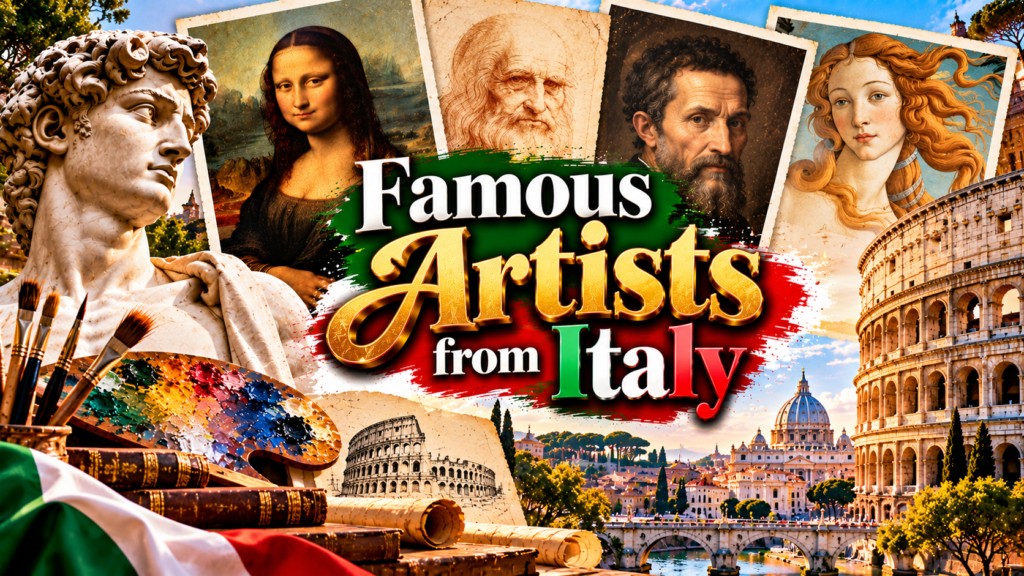
Italian art developed through several important periods, including:
- The Renaissance: A period of renewed interest in classical learning, realism, science, and human achievement.
- The Baroque period: An artistic movement known for dramatic lighting, intense emotions, movement, and grandeur.
- Neoclassicism: A return to the balanced forms and classical ideals of ancient Greece and Rome.
- Modern and contemporary art: Movements that challenged traditional artistic conventions through experimentation, abstraction, and new materials.
Together, these developments established Italy as a lasting centre of global artistic heritage.
1. Who Was Leonardo da Vinci and Why Is He So Famous?
Leonardo da Vinci (1452–1519) is widely regarded as one of the greatest artists and thinkers in history. Born in Vinci, near Florence, he was a painter, inventor, engineer, scientist, anatomist, and observer of the natural world. His extraordinary curiosity helped him connect artistic creativity with scientific investigation.
Leonardo’s paintings are celebrated for their realistic details, subtle expressions, sophisticated composition, and innovative use of light and shadow. He carefully studied human anatomy and facial expressions to make his figures appear lifelike. His technique known as sfumato created soft transitions between colours and tones, giving his paintings a distinctive atmospheric quality.
His most famous works include:
- Mona Lisa: A portrait renowned for its mysterious smile and subtle expression.
- The Last Supper: A monumental mural depicting Jesus Christ’s final meal with his disciples.
- The Virgin of the Rocks: A religious painting demonstrating his mastery of composition and atmospheric perspective.
The Mona Lisa, displayed at the Louvre Museum in Paris, is among the most recognised paintings in the world. Meanwhile, The Last Supper in Milan remains an important landmark of Renaissance art.
Leonardo’s influence extends beyond painting. His notebooks contain observations and designs related to flying machines, anatomy, engineering, and mechanics. Although many of his inventions remained unrealised during his lifetime, his work demonstrates the close relationship between science and creativity.
2. Why Is Michelangelo Considered One of Italy’s Greatest Artists?
Michelangelo Buonarroti (1475–1564) was a celebrated Italian sculptor, painter, architect, and poet. Born in Caprese, he became one of the defining figures of the High Renaissance. His ability to represent the human body with extraordinary precision and emotional intensity established a new standard for artistic achievement.
Michelangelo believed that sculpture revealed the form already contained within the stone. His marble figures display impressive anatomical detail, balanced proportions, and a powerful sense of movement.
Some of his most famous masterpieces include:
- David: A monumental marble sculpture representing the biblical hero before his battle with Goliath.
- Pietà: A moving sculpture showing Mary holding the body of Jesus after the Crucifixion.
- The Creation of Adam: A celebrated scene on the ceiling of the Sistine Chapel.
- The Last Judgment: A dramatic fresco covering the altar wall of the Sistine Chapel.
Michelangelo’s ceiling frescoes in the Sistine Chapel in Vatican City are among the most celebrated achievements of Western art. Their expressive figures, complex compositions, and religious themes demonstrate his exceptional artistic skill.
He also contributed to the architectural development of St. Peter’s Basilica in Rome. His work influenced generations of sculptors, painters, and architects, making him one of the most important figures in Italian cultural history.
3. Who Was Raphael and What Made His Art Special?
Raphael Sanzio (1483–1520), commonly known as Raphael, was one of the leading painters of the Italian High Renaissance. Born in Urbino, he became famous for the harmony, clarity, and balanced composition of his paintings.
While Michelangelo often explored powerful muscular forms and Leonardo focused on subtle observation, Raphael developed a distinctive style characterised by graceful figures, carefully organised spaces, and serene expressions. His ability to combine beauty with intellectual depth made his paintings highly influential.
His best-known works include:
- The School of Athens: A monumental fresco featuring ancient philosophers, including Plato and Aristotle.
- Sistine Madonna: A celebrated painting of the Virgin Mary holding the Christ Child.
- The Transfiguration: A dramatic religious composition completed near the end of his life.
- Madonna of the Meadow: A graceful depiction of Mary with the young Jesus and John the Baptist.
The School of Athens, located in the Vatican’s Raphael Rooms, is especially famous for its representation of classical philosophy. It reflects the Renaissance interest in knowledge, reason, and the intellectual achievements of ancient Greece.
Raphael died at the age of 37, but his influence on European painting continued for centuries. His work became an important model for artists seeking harmony, ideal beauty, and compositional balance.
4. Why Is Sandro Botticelli One of the Most Famous Italian Painters?
Sandro Botticelli (c. 1445–1510) was a Florentine painter whose elegant figures and mythological subjects made him one of the most recognisable artists of the early Renaissance.
Unlike many religious paintings of his time, Botticelli’s work frequently explored classical mythology alongside Christian themes. His paintings often feature flowing hair, delicate outlines, graceful movement, and a dreamlike atmosphere.
His most famous masterpieces include:
- The Birth of Venus: A mythological painting showing Venus emerging from the sea on a shell.
- Primavera: A richly symbolic composition featuring mythological figures in an elaborate garden.
- Adoration of the Magi: A religious scene that includes portraits associated with members of Florence’s influential Medici circle.
The Birth of Venus is particularly famous for its idealised representation of beauty and its connection to classical mythology. The painting has become an enduring symbol of Renaissance art.
Botticelli worked during a period when Florence encouraged the study of literature, philosophy, and classical culture. His paintings reflect these intellectual interests while maintaining a distinctive poetic quality.
Although his reputation declined for a time after his death, later generations rediscovered his work. Today, Botticelli is considered one of the most important artists of the Italian Renaissance.
5. Who Was Caravaggio and How Did He Transform Italian Painting?
Michelangelo Merisi da Caravaggio (1571–1610), known as Caravaggio, was an influential Italian Baroque painter celebrated for his dramatic realism and powerful use of light and shadow.
Caravaggio rejected idealised representations of religious figures and often portrayed them with the physical features, expressions, and clothing of ordinary people. His approach made biblical scenes feel immediate, human, and emotionally compelling.
His signature technique, known as chiaroscuro, uses strong contrasts between light and darkness. In his paintings, focused illumination often emerges from a dark background, directing attention towards the central figures and intensifying the emotional impact.
Some of his most famous works include:
- The Calling of Saint Matthew: A dramatic religious scene featuring a striking beam of light.
- Judith Beheading Holofernes: A powerful depiction of the biblical heroine confronting an enemy commander.
- The Supper at Emmaus: A painting exploring surprise, recognition, and religious revelation.
- Bacchus: A notable work depicting the Roman god of wine.
Caravaggio influenced generations of painters across Europe, including artists who adopted his dramatic lighting and realistic figures. His approach helped establish the visual language of Baroque painting.
His life was also marked by personal conflict and legal difficulties, and he died in 1610 under circumstances that remain the subject of historical discussion. Despite his turbulent life, his artistic innovations transformed European painting.
6. Why Is Titian Important in the History of Italian Art?
Titian (c. 1488–1576), also known as Tiziano Vecellio, was a leading painter of the Venetian Renaissance. He became famous for his rich colours, expressive brushwork, and ability to portray the textures of skin, fabric, landscapes, and luxurious objects.
While Florentine artists often emphasised drawing and carefully defined outlines, Venetian painters developed a strong interest in colour and atmosphere. Titian became one of the greatest representatives of this tradition.
His celebrated works include:
- Assumption of the Virgin: A monumental religious painting in Venice.
- Venus of Urbino: A famous reclining female nude.
- Bacchus and Ariadne: A mythological scene full of movement and vibrant colour.
- Portrait of Charles V with a Dog: An example of his skill in royal portraiture.
Titian worked for powerful patrons, including European rulers and members of the Habsburg dynasty. His portraits helped establish a visual language of authority and prestige.
His influence extended beyond Italy, inspiring artists who admired his colour techniques and expressive handling of paint. Titian’s long career also demonstrates how Italian Renaissance art continued to evolve through experimentation.
7. Who Was Donatello and Why Is His Sculpture Significant?
Donatello (c. 1386–1466) was one of the most important sculptors of the early Italian Renaissance. Born in Florence, he helped revive classical approaches to sculpture while developing a more naturalistic representation of the human body.
His works reveal a deep understanding of anatomy, posture, facial expression, and emotional character. Donatello experimented with marble, bronze, wood, and relief sculpture, demonstrating remarkable versatility.
His most notable works include:
- David: A celebrated bronze sculpture of the biblical hero.
- Gattamelata: An influential equestrian monument in Padua.
- Saint George: A sculpture known for its confident posture and expressive presence.
- Penitent Magdalene: A powerful wooden sculpture depicting Mary Magdalene in a state of spiritual reflection.
Donatello’s bronze David is especially significant because it is widely regarded as the first freestanding nude male sculpture of the Renaissance since antiquity.
His innovations influenced later sculptors, including Michelangelo, and helped establish sculpture as a major expression of Renaissance humanism.
8. Why Is Giovanni Bellini Celebrated as a Master of Venetian Art?
Giovanni Bellini (c. 1430–1516) was a major Venetian Renaissance painter whose work helped transform the use of colour, light, and landscape in Italian painting.
Bellini developed a refined approach to oil painting, allowing him to create luminous colours, soft atmospheric effects, and subtle transitions between figures and their surroundings. His religious compositions often combine spiritual serenity with a convincing natural environment.
Important works associated with Bellini include:
- San Zaccaria Altarpiece: A celebrated religious composition known for its balanced arrangement.
- The Agony in the Garden: A contemplative scene exploring the emotional experience of Christ.
- Madonna and Child paintings: Works that demonstrate his sensitivity to facial expression and human tenderness.
Bellini also influenced younger Venetian painters, including Giorgione and Titian. His approach helped establish the Venetian tradition of rich colour and atmospheric painting, which became one of the defining features of Renaissance art.
9. Who Was Artemisia Gentileschi and Why Is She Important?
Artemisia Gentileschi (1593–c. 1653) was one of the most accomplished women painters of the Italian Baroque period. Working in a male-dominated artistic world, she gained recognition for her dramatic compositions, powerful female figures, and masterful use of light and shadow.
She trained in the artistic environment of Rome and developed a style influenced by Caravaggio while establishing her own distinctive voice. Her paintings frequently explore biblical and historical women, presenting them as determined, complex, and active participants in their stories.
Her most famous works include:
- Judith Slaying Holofernes: A dramatic depiction of the biblical heroine defeating an enemy general.
- Susanna and the Elders: A painting exploring a biblical story involving vulnerability and unwanted attention.
- Self-Portrait as the Allegory of Painting: A celebrated representation of the artist herself.
Gentileschi’s career took her to several important artistic centres, including Florence, Rome, Naples, and London. She received commissions from influential patrons and established herself as a professional painter.
Today, her achievements are recognised as a significant part of Italian art history. Her work also contributes to wider discussions about women’s participation, recognition, and representation in the arts.
10. Why Is Amedeo Modigliani Famous for His Modern Art?
Amedeo Modigliani (1884–1920) was an Italian modern artist known for his distinctive portraits and elongated human figures. Born in Livorno, he spent much of his artistic career in Paris, where he became associated with the international avant-garde art scene.
Modigliani’s paintings and sculptures combined influences from classical art, African sculpture, and modern European movements. His portraits are characterised by elongated necks, simplified facial features, almond-shaped eyes, and flowing lines.
His best-known works include:
- Jeanne Hébuterne portraits: Images of his partner and fellow artist.
- Reclining Nude: Part of his celebrated series of nude paintings.
- Head sculptures: Sculptural works featuring elongated forms and stylised facial features.
Modigliani’s art differs considerably from the detailed realism of Renaissance painters. Instead, he simplified the human form to create elegant, expressive compositions.
Although he experienced financial difficulties and poor health during his lifetime, his work became highly influential after his death. Today, his paintings and sculptures are recognised for their distinctive style and importance in modern art.
11. Who Was Giorgio de Chirico and How Did He Influence Modern Art?
Giorgio de Chirico (1888–1978) was an Italian artist best known for founding the Metaphysical Art movement, which explored mysterious spaces, unusual combinations of objects, and dreamlike environments.
His paintings often feature empty city squares, classical architecture, long shadows, statues, mannequins, and distant horizons. These elements create an atmosphere of uncertainty, encouraging viewers to question the relationship between reality and imagination.
Notable works include:
- The Song of Love: A striking composition combining unrelated objects in an unsettling setting.
- The Mystery and Melancholy of a Street: A painting featuring a deserted architectural space and dramatic shadows.
- The Disquieting Muses: A mysterious scene with classical buildings and mannequin-like figures.
De Chirico’s paintings influenced the development of Surrealism, although his Metaphysical Art had its own distinctive philosophy and artistic identity.
His work encouraged artists to move beyond literal representations of the world and explore psychological tension, symbolism, and the hidden meanings of familiar objects.
12. Which Other Famous Italian Artists Should You Know?
Italy’s artistic heritage extends far beyond its most celebrated Renaissance and Baroque masters. Many other artists made important contributions to painting, sculpture, architecture, and modern artistic movements.
Here are several additional Italian artists worth exploring.
Giorgio Vasari
Giorgio Vasari (1511–1574) was a painter, architect, and writer who played a major role in documenting Renaissance art. His book Lives of the Most Excellent Painters, Sculptors, and Architects remains an important historical source for understanding artists and artistic developments of his time.
Tintoretto
Jacopo Tintoretto (1518–1594) was a Venetian painter known for energetic compositions, dramatic perspectives, and expressive brushwork. His large religious paintings helped shape the transition from the Renaissance to the Baroque period.
Gian Lorenzo Bernini
Gian Lorenzo Bernini (1598–1680) was a leading Baroque sculptor and architect. His works, including Apollo and Daphne and The Ecstasy of Saint Teresa, are celebrated for their movement, theatrical expression, and extraordinary attention to detail.
Antonio Canova
Antonio Canova (1757–1822) was a leading Neoclassical sculptor whose elegant marble figures revived the balanced proportions and idealised beauty associated with classical antiquity. His famous works include Psyche Revived by Cupid’s Kiss and The Three Graces.
Umberto Boccioni
Umberto Boccioni (1882–1916) was an important figure in Italian Futurism. His work explored movement, speed, modern technology, and the energy of urban life. His sculpture Unique Forms of Continuity in Space is a landmark of modern sculpture.
Giorgio Morandi
Giorgio Morandi (1890–1964) was an Italian painter famous for his still-life compositions featuring bottles, jars, and simple domestic objects. Through subtle colours and carefully arranged forms, he explored balance, light, and the relationship between objects and space.
Lucio Fontana
Lucio Fontana (1899–1968) was an influential modern artist associated with Spatialism. He became known for canvases featuring cuts and punctures that challenged traditional ideas about painting, space, and the physical limits of an artwork.
These artists demonstrate how Italian creativity continued to evolve long after the Renaissance, influencing European and international art in different ways.
13. How Did the Italian Renaissance Change the World of Art?
The Italian Renaissance transformed art by encouraging artists to study nature, human anatomy, mathematics, classical literature, and philosophy. Rather than relying exclusively on established artistic conventions, painters and sculptors increasingly sought to understand how the visible world worked.
Several important developments emerged during this period.
Perspective and realistic space: Artists developed techniques for creating the illusion of depth on flat surfaces. Linear perspective helped architectural settings and landscapes appear more convincing.
Human anatomy: Artists carefully studied muscles, bones, posture, and movement to create more lifelike figures.
Humanism: Renaissance thinkers placed greater emphasis on human potential, classical learning, and individual achievement. These ideas influenced portraits, historical scenes, and representations of the human body.
Scientific observation: Artists such as Leonardo da Vinci investigated natural phenomena, combining close observation with artistic experimentation.
Patronage and artistic workshops: Wealthy families, religious institutions, and political leaders funded ambitious projects, giving artists opportunities to develop new techniques.
These developments did not occur everywhere at the same time, nor were they exclusive to Italy. However, Italian artists and cities played a particularly influential role in shaping the artistic language of the European Renaissance.
14. Where Can You See the Masterpieces of Famous Italian Artists?
Italy offers numerous museums, churches, palaces, and public spaces where visitors can experience masterpieces by renowned artists. Many artworks remain in their original locations, allowing travellers to connect artistic achievements with the historical settings in which they were created.
Some important destinations include:
- Uffizi Gallery, Florence: Famous for Renaissance paintings by Botticelli, Leonardo da Vinci, and other Italian masters.
- Accademia Gallery, Florence: Home to Michelangelo’s celebrated marble sculpture David.
- Vatican Museums, Vatican City: Known for the Sistine Chapel ceiling by Michelangelo and Raphael’s frescoes in the Raphael Rooms.
- Santa Maria delle Grazie, Milan: The location of Leonardo da Vinci’s The Last Supper.
- Galleria Borghese, Rome: Celebrated for sculptures by Bernini and paintings by several major Italian artists.
- Gallerie dell’Accademia, Venice: An important collection of Venetian painting, including works associated with Bellini and other masters.
- Brera Art Gallery, Milan: A major collection of Italian painting spanning several centuries.
- Capodimonte Museum, Naples: Houses significant works from the Renaissance and Baroque periods.
Travellers should check official museum websites for current opening hours, admission requirements, temporary closures, and advance booking rules. Some famous artworks require timed reservations, and conservation work can occasionally affect access.
15. What Can We Learn from Italy’s Most Famous Artists?
The achievements of famous Italian artists demonstrate that creativity develops through curiosity, discipline, experimentation, and the exchange of ideas. Leonardo da Vinci shows the value of observing the world carefully. Michelangelo demonstrates the power of technical mastery and expressive form. Raphael reveals how balance and harmony can strengthen a composition, while Caravaggio illustrates the emotional impact of light and realism.
Modern artists such as Modigliani, Boccioni, Morandi, and Fontana show that artistic innovation does not end with established traditions. Each explored different ways to represent the human experience, modern society, or the physical nature of art.
Their work also reminds us that artistic achievement is shaped by historical circumstances. Patronage, religious institutions, political power, technological developments, and cultural exchange all influenced the subjects artists explored and the materials they used.
For contemporary readers, the legacy of Italian art offers several valuable lessons:
- Study the past while remaining open to new ideas.
- Develop technical skills through practice and observation.
- Use creativity to communicate emotion, meaning, and personal experience.
- Experiment with different materials, styles, and perspectives.
- Recognise the contributions of artists from diverse backgrounds.
- Preserve cultural heritage so that future generations can learn from it.
Conclusion: Why Do Famous Artists from Italy Continue to Inspire the World?
Famous artists from Italy have left an extraordinary legacy that spans centuries, from the innovative experiments of the Renaissance to the expressive power of Baroque sculpture and the bold ideas of modern art. Leonardo da Vinci, Michelangelo, Raphael, Botticelli, Caravaggio, Titian, Donatello, Artemisia Gentileschi, and many others transformed artistic traditions through their imagination, technical ability, and distinctive visions.
Their paintings, sculptures, and architectural achievements continue to attract visitors to Italian museums, churches, and historic cities. At the same time, their influence reaches far beyond Italy, shaping art education, popular culture, design, and the way people understand creativity.
Exploring the most famous artists from Italy is therefore more than a journey through celebrated names and masterpieces. It is an opportunity to discover how art reflects human ambition, emotion, faith, knowledge, and cultural change. Whether you admire Renaissance portraits, dramatic Baroque paintings, elegant Neoclassical sculptures, or experimental modern works, Italy’s artistic heritage offers an endless source of inspiration.
For anyone interested in European culture, history, or travel, learning about Italy’s greatest artists provides a meaningful starting point for understanding one of the world’s richest artistic traditions.
Read More – History of Parisian Fashion