
Why Is It Important to Connect With the Europe Global Economy?
How can individuals, businesses, entrepreneurs, and investors connect with the Europe global economy? In today’s interconnected world, Europe plays an important role in international trade, financial markets, technological innovation, tourism, manufacturing, and sustainable development. From established industrial economies to emerging business hubs, European countries offer opportunities for people and organizations looking to expand their knowledge, build professional relationships, and participate in international markets.
Connecting with the Europe global economy is not limited to large corporations or experienced investors. Students can explore educational opportunities, entrepreneurs can identify potential customers, professionals can develop international careers, and small businesses can discover new suppliers and markets. Understanding European economic trends can also help readers make informed decisions about global business and employment.
However, successful participation requires more than simply following economic news. It involves understanding regional differences, researching regulations, developing relevant skills, building professional networks, and using reliable information. So, how can you connect with the Europe global economy and benefit from its international reach? Let’s explore the most practical approaches.
1. What Is the Europe Global Economy?
The Europe global economy refers to Europe’s participation in international economic activities, including trade, investment, manufacturing, financial services, digital technology, energy, tourism, and employment. European economies are connected with countries across Asia, Africa, North America, South America, and other regions through the movement of goods, services, capital, technology, and skilled workers.
The European Union (EU) is a major part of this economic landscape, but Europe is larger than the EU. Countries such as the United Kingdom, Switzerland, and Norway also have important international economic relationships. Each country has its own economic structure, business environment, regulations, and opportunities.
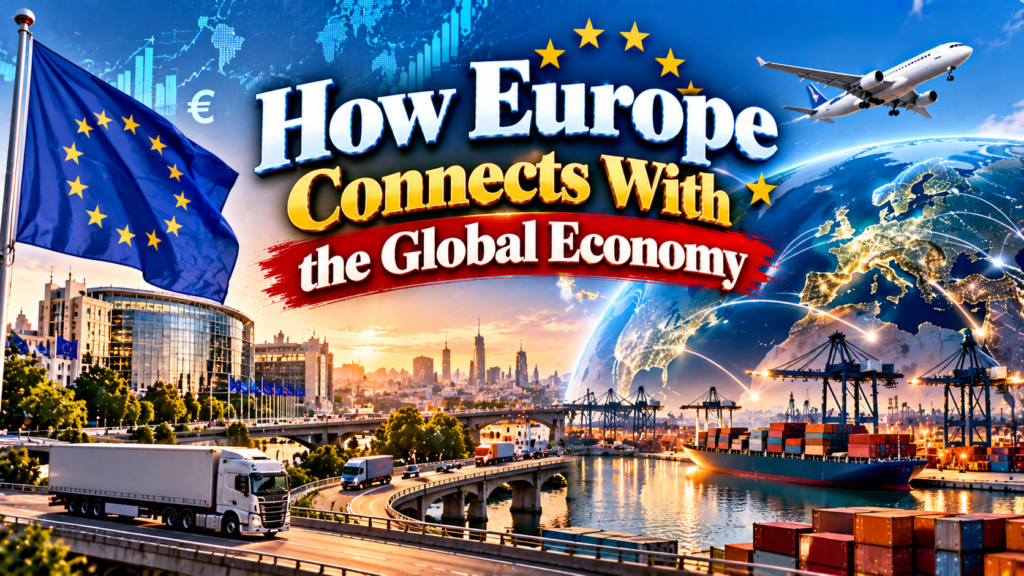
European economic activity covers several important sectors:
- Manufacturing and engineering: Germany, Italy, and other European countries have established industrial and manufacturing industries.
- Financial services: London, Frankfurt, Paris, Zurich, and other financial centres support banking, investment, insurance, and international business.
- Technology and innovation: European companies and research institutions contribute to software, artificial intelligence, biotechnology, and advanced engineering.
- Tourism and hospitality: European destinations attract international visitors and support travel-related businesses.
- Renewable energy: European markets are developing opportunities in wind power, solar energy, energy efficiency, and clean technologies.
- Agriculture and food production: European countries participate in global food supply chains and agricultural trade.
Understanding these sectors helps individuals identify where their interests, skills, products, or services may fit within the broader European market.
2. Why Should You Connect With the European Economy?
Why is connecting with the European economy valuable for individuals and businesses? One major reason is that international economic connections can create opportunities beyond domestic markets. Businesses may find new customers, professionals may discover career paths, and entrepreneurs may learn from established industries and emerging technologies.
European markets can also provide access to international partnerships, research institutions, trade networks, and business events. For companies that want to expand internationally, studying European customer preferences and industry standards can help them develop more competitive products and services.
There are several potential benefits:
- Business expansion: Reach customers in new countries and diversify revenue sources.
- Career development: Explore international employment opportunities and improve professional skills.
- Entrepreneurship: Identify market gaps, potential suppliers, and collaboration opportunities.
- Education and research: Connect with universities, innovation centres, and research programmes.
- Investment knowledge: Understand economic indicators, industry developments, and market risks.
- Cultural understanding: Learn how consumer behaviour, workplace expectations, and business practices differ across countries.
These benefits are not guaranteed. Success depends on preparation, market demand, legal compliance, and the ability to build reliable relationships.
3. How Can You Stay Updated on European Economic News?
How can you understand what is happening in the Europe global economy? The first step is to follow credible news sources and official economic publications. Economic developments can influence business costs, investment decisions, trade flows, employment, and consumer confidence.
Readers should look beyond headlines and understand the indicators behind economic news. For example, inflation measures changes in prices, gross domestic product (GDP) tracks the value of economic output, and unemployment statistics provide information about labour-market conditions. Interest rates can influence borrowing costs, spending, and investment.
Useful sources include:
- Eurostat: Official statistical information about the European Union.
- European Central Bank (ECB): Monetary policy, inflation, financial stability, and euro-area economic analysis.
- European Commission: Economic forecasts, policy updates, trade information, and reports.
- Organisation for Economic Co-operation and Development (OECD): Comparative economic data and policy research.
- International Monetary Fund (IMF): Global economic outlooks and country-level economic assessments.
- National statistical offices: Country-specific information about employment, inflation, production, and trade.
For a balanced understanding, compare official data with reputable business journalism and industry reports. Pay attention to publication dates, methodology, and the difference between forecasts and confirmed results.
For readers of Europe Saga, following developments in trade, employment, technology, energy, and consumer spending can provide a useful foundation for understanding how Europe interacts with the global economy.
4. How Can Businesses Enter European Markets?
How can a business connect with European customers and establish an international presence? Businesses should begin by identifying the countries where their products or services are most likely to meet customer needs. Europe is not a single uniform market. Consumer preferences, purchasing power, languages, distribution networks, and regulatory requirements can vary significantly from one country to another.
A business selling fashion products, for instance, may need a different marketing strategy for France than for Germany or the Netherlands. Similarly, a software company may need to consider local languages, data protection requirements, pricing expectations, and customer support arrangements.
A practical market-entry process includes the following steps:
- Research demand: Identify customer needs, competitors, market size, and pricing expectations.
- Choose a target country: Compare potential markets based on demand, costs, logistics, and competition.
- Study legal requirements: Check product standards, taxes, consumer protection, and sector-specific regulations.
- Select a sales channel: Consider distributors, local agents, business-to-business sales, online stores, or marketplaces.
- Develop a local marketing strategy: Adapt messaging, language, customer service, and payment options.
- Build business relationships: Contact potential partners, attend relevant trade events, and verify prospective suppliers.
- Test before expanding: Start with a limited launch, evaluate results, and adjust the strategy.
Companies outside Europe should also investigate customs procedures, import duties, rules of origin, and applicable trade agreements. Businesses selling within the EU must determine which EU rules apply to their products and whether additional national requirements exist.
A carefully researched market-entry plan can help businesses reduce avoidable costs and build a more sustainable international presence.
5. How Can Small Businesses and Entrepreneurs Benefit From Europe?
Can small businesses participate in the European economy without having a large international office? Yes. Digital platforms, specialised services, online networking, and international supply chains have made cross-border business more accessible, although legal and operational barriers remain.
Small businesses can explore opportunities in software development, digital marketing, design, consulting, education, creative services, manufacturing, food products, and specialised business support. The best opportunities depend on a company’s capabilities, target customers, pricing, and ability to meet relevant requirements.
Entrepreneurs can start by identifying a specific problem faced by European customers. They should then research existing solutions, assess competitors, and determine whether their offering provides a clear advantage.
For example, a small technology company might offer a specialised software service to European manufacturers. A design agency could work with international retailers, while a consulting firm might support businesses with research, content, or digital operations.
Useful strategies include:
- Create a professional website with clear service information and contact details.
- Prepare a company profile, portfolio, and case studies.
- Research European industry directories and business associations.
- Use professional networking platforms to identify potential clients.
- Attend relevant trade fairs, webinars, and virtual business events.
- Establish transparent contracts, payment terms, delivery schedules, and customer support.
- Check applicable tax, invoicing, privacy, and business-registration obligations.
Entrepreneurs should avoid assuming that access to an online marketplace automatically provides access to every European country. Platform rules, consumer laws, product restrictions, and tax obligations may differ.
6. How Can You Find International Trade and Export Opportunities?
How can companies identify opportunities to export products or services to Europe? Export planning begins with understanding what European buyers need and whether the business can deliver products at a competitive price and consistent quality.
Companies should research import demand, existing suppliers, shipping costs, customs procedures, and the regulatory requirements for their products. Trade data can help identify markets where demand exists, while industry events can provide direct access to potential buyers.
Businesses can investigate resources such as the European Commission’s Access2Markets portal, which provides information about tariffs, taxes, product requirements, customs procedures, and rules of origin for relevant trade scenarios.
An export-readiness checklist should include:
- Confirming product quality and technical specifications.
- Checking labelling, packaging, safety, and conformity requirements.
- Calculating production, transport, insurance, and customs-related costs.
- Identifying reliable freight forwarders and logistics partners.
- Understanding payment risks and currency exposure.
- Preparing accurate commercial invoices and export documentation.
- Verifying the buyer’s business identity and payment history.
Companies should also consider whether their product requires certification, special permits, sanitary controls, or other approvals. Requirements can be particularly important for food, cosmetics, medical products, electronics, chemicals, and other regulated categories.
A strong export strategy combines market research, regulatory preparation, reliable logistics, and long-term customer relationships.
7. How Can Professionals Connect With European Career Opportunities?
How can professionals participate in the European economy through employment and skill development? European companies recruit across a range of sectors, including engineering, information technology, healthcare, research, finance, hospitality, renewable energy, logistics, and professional services.
However, job opportunities differ by country and occupation. Language requirements, professional qualifications, work permits, and local labour-market conditions can influence a candidate’s eligibility.
Professionals should begin by identifying countries and industries that match their qualifications. They can then research employers, compare job descriptions, and determine whether their skills meet local requirements.
Practical steps include:
- Build a clear, achievement-focused CV and professional portfolio.
- Update professional profiles with relevant skills and experience.
- Search employer career pages and recognised job platforms.
- Research work authorisation and visa requirements before accepting employment.
- Check whether professional qualifications require recognition or licensing.
- Develop language skills relevant to the intended country and occupation.
- Attend virtual recruitment events and industry networking sessions.
International applicants should be cautious of recruitment agencies or individuals who promise guaranteed jobs or visas in exchange for suspicious advance payments. Verify employers and recruitment organisations before sharing sensitive documents or transferring money.
For students and early-career professionals, internships, academic partnerships, international conferences, and research collaborations may provide additional ways to develop European professional connections.
8. How Can Digital Technology Help You Connect With Europe?
How has digital technology changed access to the European economy? Digital tools enable businesses and individuals to research markets, communicate across borders, collaborate remotely, and deliver services internationally.
Video meetings, cloud-based software, digital payments, e-commerce platforms, and professional networking websites can reduce the need for physical travel during the early stages of an international partnership. Companies can also use digital analytics to understand customer behaviour and improve marketing decisions.
Technology-related opportunities extend beyond online retail. European organisations need services involving cybersecurity, artificial intelligence, software engineering, data analysis, digital accessibility, and business automation.
To build useful digital connections, individuals and businesses should:
- Maintain a professional online presence.
- Publish relevant expertise, research, or industry insights.
- Participate in online communities connected to European industries.
- Attend virtual exhibitions, conferences, and business meetings.
- Use secure communication and payment systems.
- Protect customer data and comply with applicable privacy requirements.
- Evaluate digital service providers before entering commercial agreements.
Digital connectivity does not remove the need for trust. Businesses should verify partners, document agreements, and use appropriate security measures when exchanging financial or confidential information.
9. How Can You Understand European Financial Markets and Investment Trends?
How can individuals learn about Europe’s role in international finance? European financial markets include banking, bonds, equities, insurance, foreign exchange, pension systems, and investment funds. Their performance is influenced by interest rates, corporate earnings, inflation, government policies, geopolitical developments, and global economic conditions.
Learning about these markets can help readers understand the broader economic environment, but economic news should not be treated as a guaranteed prediction of investment returns.
People interested in financial markets can begin by studying basic concepts such as diversification, risk tolerance, asset allocation, market volatility, and currency exposure. They can then follow official central-bank publications, market disclosures, and reputable financial research.
Before making investment decisions, consider:
- Your financial goals and investment time horizon.
- The risks associated with individual assets and markets.
- Currency fluctuations between your home currency and the euro or other currencies.
- Transaction fees, taxes, and applicable investment regulations.
- The reliability and regulatory status of financial intermediaries.
Investors outside Europe should also examine the rules that apply in their own country. Cross-border investment may involve additional tax reporting, foreign-exchange costs, and restrictions. Professional advice may be appropriate for complex financial decisions.
For readers who are not investors, understanding European interest rates, inflation, and financial conditions can still help explain changes in borrowing costs, company spending, and international trade.
10. How Can You Build Strong European Business Networks?
Why are professional relationships important when connecting with the Europe global economy? Business networks help people discover opportunities, exchange knowledge, build trust, and develop partnerships. A strong network may also provide insights into customer expectations and local business practices that are difficult to learn from online research alone.
Networking should focus on building genuine relationships rather than collecting contacts. Before approaching a potential partner, research their organisation, industry, and business priorities. Explain clearly how a conversation could be useful to both sides.
Effective networking methods include:
- Joining relevant chambers of commerce and trade associations.
- Participating in international conferences and sector-specific exhibitions.
- Attending webinars and professional workshops.
- Connecting with industry experts through professional networking platforms.
- Contacting university research centres and innovation networks.
- Following up after meetings with a clear and relevant message.
- Sharing useful information and maintaining consistent communication.
Business etiquette differs across countries and industries. Some organisations prefer formal introductions and detailed proposals, while others favour direct and informal communication. Learning about local customs, meeting expectations, and communication styles can make professional interactions more effective.
Trust is built over time through reliable communication, realistic promises, transparent pricing, and consistent delivery.
11. How Can Sustainability Create Opportunities in the European Economy?
How does sustainability influence Europe’s economic future? Environmental policy, energy security, resource efficiency, and changing consumer expectations have encouraged businesses to examine how they produce, transport, and sell goods and services.
Potential opportunities include renewable energy, building efficiency, sustainable packaging, recycling, low-carbon transport, environmental consulting, and technologies that help organisations measure or reduce resource consumption.
Companies interested in this area should research actual customer demand and the regulations relevant to their sector. They should also distinguish between legally required standards, voluntary certifications, and marketing claims.
Businesses can explore sustainability-related opportunities by:
- Assessing energy and material efficiency.
- Researching renewable-energy technologies and service providers.
- Investigating demand for durable, repairable, or recyclable products.
- Measuring the environmental impact of supply chains.
- Checking applicable product rules and reporting obligations.
- Communicating environmental performance accurately and transparently.
The European sustainability landscape continues to evolve, and requirements may vary by product, company size, sector, and jurisdiction. Businesses should consult current official guidance before making compliance or investment decisions.
Sustainability can support innovation and competitiveness when it responds to genuine market needs and measurable outcomes.
12. What Challenges Should You Consider Before Entering the European Economy?
Is connecting with the European economy always easy? No. Although Europe offers many opportunities, businesses and individuals must account for differences in regulation, culture, language, competition, operating costs, and economic conditions.
A product that performs well in one country may not attract the same demand elsewhere. Currency movements can affect profit margins, while changes in consumer spending or business confidence can alter market conditions. Import restrictions, taxes, product standards, and employment regulations can also create additional costs.
Common challenges include:
- Regulatory complexity: Rules can differ between EU-wide requirements and national legislation.
- Language barriers: Local-language communication may be important for sales, recruitment, and customer service.
- Competition: Established local businesses may have strong customer relationships and distribution networks.
- Financial uncertainty: Inflation, interest rates, exchange rates, and demand can change.
- Logistics: Shipping, storage, customs clearance, and delivery times affect costs.
- Trust and verification: International partnerships require careful checks and clear contracts.
- Cultural differences: Negotiation styles, workplace expectations, and purchasing habits may vary.
To manage these challenges, conduct thorough research, start with manageable commitments, and seek qualified legal, tax, or trade advice where necessary. Regularly review results and adjust plans as new information becomes available.
13. How Can You Create a Practical Plan to Connect With the Europe Global Economy?
What is the best way to turn economic knowledge into action? Start with one clearly defined goal. You might want to find European customers, explore career opportunities, research an industry, develop an export strategy, or understand international economic trends.
A structured plan helps turn a broad ambition into achievable steps.
Step 1: Define your objective. Decide what you want to achieve and how you will measure progress.
Step 2: Select a country or sector. Focus on a specific market instead of treating all of Europe as one identical opportunity.
Step 3: Gather reliable information. Use official statistics, industry reports, trade resources, and reputable news sources.
Step 4: Identify relevant contacts. Research employers, customers, suppliers, associations, or professional networks.
Step 5: Check requirements and costs. Understand applicable laws, qualifications, taxes, logistics, and financial risks.
Step 6: Take a small initial action. Attend an industry event, contact a potential partner, submit a job application, or test a product with a limited group of customers.
Step 7: Review your results. Track responses, costs, market interest, and lessons learned.
Step 8: Expand based on evidence. Invest more time and resources when the initial results justify further action.
This approach helps individuals and organisations make informed decisions while reducing the risk of committing too many resources before understanding a market.
Conclusion: How Can You Become Part of the Europe Global Economy?
Connecting with the Europe global economy begins with knowledge, but long-term participation depends on practical action. Whether you are an entrepreneur, business owner, student, professional, researcher, or reader interested in international affairs, understanding Europe’s economic structure can help you identify relevant opportunities and make better-informed decisions.
The most effective approach combines reliable economic information, market research, professional networking, digital skills, regulatory awareness, and a clear understanding of personal or business objectives. It is also important to recognise that Europe contains diverse economies, and a strategy that works in one country may need significant adjustments in another.
Start by following official economic indicators, exploring a sector that matches your interests, and identifying one realistic opportunity to investigate. Build relationships carefully, verify information before making commitments, and adapt your strategy as market conditions change.
The Europe global economy is shaped by trade, innovation, finance, employment, sustainability, and international cooperation. By understanding these connections and approaching opportunities with preparation and patience, individuals and businesses can become more informed participants in Europe’s evolving economic landscape.
For more insights into European business, global trade, economic developments, and international opportunities, follow Europe Saga for informative articles that help you understand the forces shaping Europe’s role in the world.
Read More – Best Italian Movies of All Time To Watch in 2026