
Most Famous Artists from Spain: Their Lives, Masterpieces, and Lasting Influence
Spain has produced some of the most influential artists in world history, shaping painting, sculpture, architecture, and modern art. From the dramatic religious paintings of the Spanish Golden Age to the experimental movements of the twentieth century, Spanish artists have continually transformed the way people understand and experience art. Their creations reflect the country’s rich cultural heritage, historical events, regional identities, and changing social values.
Some of the most famous artists from Spain include Pablo Picasso, Salvador Dalí, Francisco Goya, Diego Velázquez, Joan Miró, El Greco, Francisco de Zurbarán, Bartolomé Esteban Murillo, Joaquín Sorolla, and Antoni Gaudí. Each artist developed a distinctive style, contributing something unique to the international art world.
Spanish art is especially celebrated for its emotional depth, technical excellence, bold imagination, and innovative approaches to composition and color. While some artists explored religious themes and royal portraits, others challenged traditional artistic rules through surrealism, cubism, and abstract expressionism.
Understanding these artists provides a fascinating introduction to Spanish history and culture. Their masterpieces continue to attract millions of visitors to museums and galleries around the world, while their influence remains visible in contemporary painting, design, architecture, and popular culture.
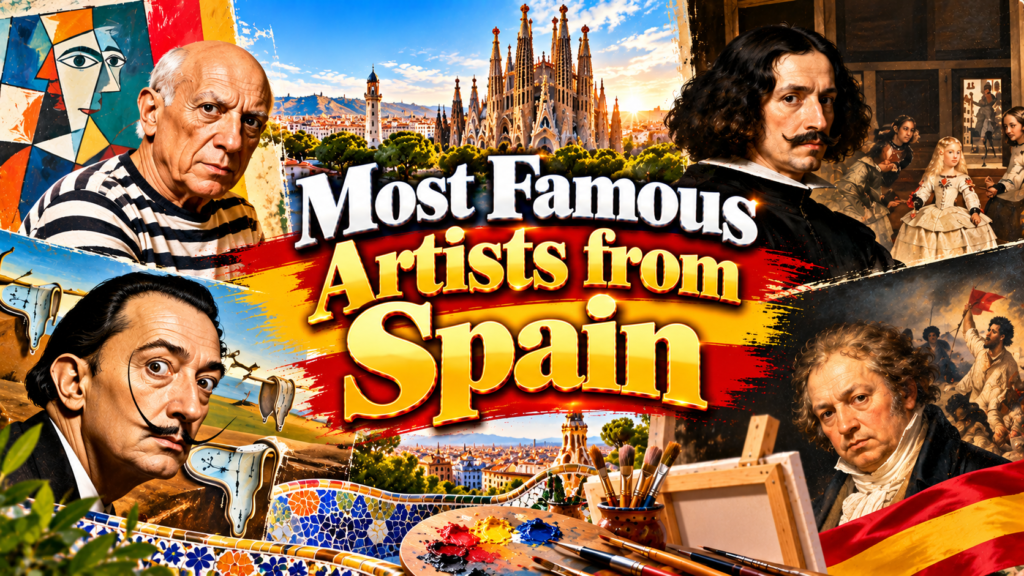
Who Was Pablo Picasso and Why Is He Considered One of Spain’s Greatest Artists? Famous Artists From Spain
Pablo Picasso is widely recognized as one of the most influential artists of the twentieth century. Born in Málaga, Spain, in 1881, Picasso demonstrated exceptional artistic ability from an early age. His father, José Ruiz Blasco, was an art teacher who helped introduce him to drawing and painting. Picasso later studied art in Spain before developing an international career that transformed modern art.
Picasso is particularly famous for co-founding Cubism with French artist Georges Braque. This revolutionary movement challenged traditional perspective by representing subjects through geometric shapes, fragmented forms, and multiple viewpoints. Rather than depicting an object from a single angle, Cubist paintings could show several perspectives simultaneously.
His artistic career included several distinct periods. The Blue Period featured melancholy paintings dominated by blue tones, often portraying poverty, loneliness, and suffering. The Rose Period introduced warmer colors and subjects such as circus performers and entertainers. His later work explored Cubism, Surrealism, sculpture, ceramics, and experimental printmaking.
One of Picasso’s most celebrated works is Guernica, painted in 1937 in response to the bombing of the Basque town of Guernica during the Spanish Civil War. The large monochromatic painting portrays the horrors of war through distorted human and animal figures. It has become an enduring symbol of civilian suffering and the devastating consequences of violence.
Other notable works include Les Demoiselles d’Avignon, The Old Guitarist, and Girl Before a Mirror. Picasso’s extraordinary versatility and willingness to challenge established conventions secured his place among the most important artists in modern history.
Why Is Salvador Dalí One of the Most Recognizable Spanish Artists?
Salvador Dalí was a Spanish painter best known for his extraordinary imagination, dreamlike imagery, and association with Surrealism. Born in Figueres, Catalonia, in 1904, Dalí became one of the movement’s most recognizable figures. His art explored dreams, subconscious thoughts, unusual associations, and the mysterious relationship between reality and imagination.
Dalí developed a highly detailed painting technique influenced by classical European masters. However, he used this traditional precision to portray impossible landscapes, distorted objects, and strange combinations of familiar things. His paintings often look realistic at first glance, yet their subjects appear to exist in a dream.
His most famous masterpiece, The Persistence of Memory (1931), depicts melting clocks draped over a barren landscape. The painting has become one of the best-known images associated with Surrealism and is frequently interpreted as a meditation on time, memory, and the instability of ordinary experience.
Other important works include The Great Masturbator and Dream Caused by the Flight of a Bee Around a Pomegranate a Second Before Awakening. Dalí also worked in sculpture, photography, film, fashion, and commercial design.
His collaborations with filmmaker Luis Buñuel, including the surrealist films Un Chien Andalou and L’Âge d’Or, helped extend his influence beyond painting.
Dalí’s flamboyant personality and distinctive appearance made him a cultural icon. Today, visitors can explore his artistic legacy at the Dalí Theatre-Museum in Figueres, which reflects his fascination with theatrical presentation and imaginative worlds.
What Made Francisco Goya a Revolutionary Spanish Painter?
Francisco José de Goya y Lucientes, commonly known as Francisco Goya, was a major Spanish painter and printmaker born in 1746. His career connected the artistic traditions of the eighteenth century with the darker, more experimental approaches that emerged during the nineteenth century.
Goya initially gained recognition for portraits, decorative designs, and paintings created for Spain’s royal court. His ability to capture personality, clothing, and social status made him a sought-after portraitist. However, his art eventually became increasingly critical, emotional, and politically aware.
One of his most famous paintings is The Third of May 1808, which depicts the execution of Spanish civilians by French troops during the Peninsular War. The painting emphasizes the terror and vulnerability of ordinary people confronted by military violence. Its dramatic lighting and powerful composition influenced later artists who sought to portray the realities of war.
Another celebrated work, The Nude Maja, became famous for its direct presentation of the human figure. Goya also created the print series The Disasters of War, which documented the brutality and suffering associated with armed conflict.
In his later years, Goya produced the disturbing series known as the Black Paintings, originally painted on the walls of his house. Works such as Saturn Devouring His Son reveal a darker side of his imagination, exploring fear, violence, and psychological turmoil.
Goya’s willingness to question authority and portray uncomfortable realities helped establish him as a transitional figure between traditional court painting and modern artistic expression.
Who Was Diego Velázquez and Why Is His Art Still Celebrated?
Diego Rodríguez de Silva y Velázquez was one of the leading painters of Spain’s Golden Age. Born in Seville in 1599, he became famous for his naturalistic style, sophisticated compositions, and remarkable ability to portray light, texture, and human character.
Velázquez eventually became the principal court painter to King Philip IV of Spain. His responsibilities included creating royal portraits and other works that reflected the power and prestige of the Spanish monarchy. Despite his royal position, his paintings frequently display a remarkable sensitivity toward the people he portrayed.
His most famous painting, Las Meninas (1656), is celebrated for its complex arrangement of figures, mirrors, and viewpoints. The painting depicts the young Infanta Margarita surrounded by members of her household, while Velázquez himself appears at his easel. Its composition raises intriguing questions about the relationship between the artist, the subject, and the viewer.
Another major work is The Surrender of Breda, which portrays a military victory with an unusual emphasis on dignity and human interaction rather than simple triumphalism.
Velázquez’s skill in reproducing fabrics, skin, reflections, and atmospheric effects influenced generations of painters. His loose yet precise brushwork also attracted admiration from later artists, including Édouard Manet.
Today, Velázquez is regarded as one of the greatest portrait painters in European art history. His work remains central to understanding the achievements of the Spanish Golden Age.
How Did Joan Miró Influence Modern Art?
Joan Miró was a Spanish Catalan artist born in Barcelona in 1893. He became known for his colorful abstract paintings, playful symbols, and imaginative visual language. His work combined influences from Surrealism, abstraction, Catalan culture, and his personal fascination with the natural world.
Miró’s paintings often include simplified figures, stars, birds, lines, circles, and brightly colored shapes arranged across open backgrounds. Rather than reproducing reality, he used these elements to suggest movement, emotion, and imaginative associations.
His artistic development coincided with major changes in European modernism. Miró experimented with different approaches to composition, gradually creating a visual style that was both recognizable and highly individual.
Among his important works are The Farm, The Harlequin’s Carnival, and Blue I, Blue II, Blue III. The Blue triptych demonstrates how a limited color palette and relatively simple marks can create a powerful visual experience.
Miró also worked in sculpture, ceramics, textiles, and printmaking. His public artworks and collaborations brought his imaginative language into spaces beyond traditional galleries.
His influence can be seen in abstract painting, graphic design, illustration, and contemporary visual culture. Miró demonstrated that art could communicate through rhythm, color, symbols, and spontaneous forms without depending on realistic representation.
Why Is El Greco Important in Spanish Art History?
El Greco, whose name means “the Greek,” was born Doménikos Theotokópoulos in Crete around 1541. Although he was not Spanish by birth, he became one of the most celebrated artists associated with Spain after settling in Toledo.
El Greco’s artistic style combined elements of Byzantine icon painting, Italian Renaissance art, and his own expressive approach. His paintings are known for elongated figures, dramatic gestures, intense colors, and unusual compositions that often appear to stretch toward the heavens.
One of his most famous masterpieces is The Burial of the Count of Orgaz, completed in the late sixteenth century. The painting combines a detailed earthly scene with an imaginative heavenly realm, illustrating the artist’s ability to connect spiritual subjects with expressive visual drama.
Another significant work is View of Toledo, a striking landscape that presents the city through dramatic contrasts of light, dark clouds, and vivid green terrain.
El Greco’s unconventional style was not always fully appreciated in later centuries. However, modern artists and critics eventually recognized his originality and emotional intensity. His elongated figures and expressive use of color influenced later movements, including aspects of modern expressionism.
His legacy demonstrates that Spanish art developed through international exchange, combining influences from different European regions and artistic traditions.
Who Was Francisco de Zurbarán and What Was His Artistic Style?
Francisco de Zurbarán was a Spanish painter born in 1598 who became particularly famous for religious paintings and still-life compositions. Working primarily during the Spanish Golden Age, he developed a style characterized by dramatic lighting, restrained colors, and carefully observed details.
Zurbarán frequently painted monks, saints, and biblical figures. His religious works often emphasize contemplation, devotion, and spiritual discipline. Rather than filling every composition with elaborate decoration, he used simple backgrounds and strong contrasts between light and shadow to focus attention on the subject.
One of his notable works is Saint Serapion, which depicts the martyred saint in a white religious habit. The painting’s quiet composition and sensitive treatment of fabric create a powerful sense of solemnity.
Zurbarán was also highly skilled at painting ordinary objects. His still-life works reveal an extraordinary attention to texture, shape, and the subtle effects of light on ceramics, fruit, and household items.
Although he is sometimes less familiar to general audiences than Picasso or Dalí, Zurbarán played a major role in defining the religious visual culture of seventeenth-century Spain.
His works remain important examples of the relationship between artistic realism, religious devotion, and the dramatic visual language of the Baroque period.
Why Is Bartolomé Esteban Murillo Famous?
Bartolomé Esteban Murillo was a Spanish Baroque painter born in Seville in 1617. He became one of the most popular religious artists of his time, known for his gentle compositions, soft lighting, and compassionate portrayals of biblical figures.
Murillo frequently depicted the Virgin Mary, the Christ Child, saints, and scenes from Christian tradition. His paintings often present spiritual subjects with warmth and accessibility, making them appealing to religious communities and private collectors.
One of his best-known works is The Immaculate Conception of Los Venerables, which demonstrates his ability to combine graceful figures, luminous colors, and a sense of spiritual elevation.
Murillo also created paintings of children and ordinary people. His genre scenes sometimes portrayed young street children, offering glimpses of everyday life in seventeenth-century Seville.
His ability to balance religious idealism with human emotion helped establish his international reputation. During later centuries, his paintings were widely admired and collected across Europe.
Murillo’s work remains an important part of Spanish Baroque art, illustrating how religious painting could communicate both theological ideas and recognizable human feelings.
How Did Joaquín Sorolla Capture the Beauty of Spain?
Joaquín Sorolla was a Spanish painter born in Valencia in 1863. He became internationally famous for his luminous paintings of beaches, landscapes, portraits, and everyday Spanish life.
Sorolla is often associated with Impressionism and luminism, although his style developed its own distinctive characteristics. He paid particular attention to sunlight, reflections, moving water, and the changing colors of outdoor environments.
His paintings of children playing on beaches and families enjoying the Mediterranean coast are especially admired for their freshness and movement. Through confident brushwork and brilliant light effects, Sorolla captured the atmosphere of a particular moment rather than presenting a rigidly posed scene.
One of his best-known works is Sad Inheritance!, which portrays children with disabilities bathing at the seaside under the supervision of a religious figure. The painting combines social observation with a striking study of light and water.
Another major achievement is Vision of Spain, a series of large panels created for the Hispanic Society of America in New York. These works celebrate the regional cultures, landscapes, and traditional activities of Spain.
Sorolla’s art offers an appealing view of Spanish daily life and demonstrates how light can become the central subject of a painting.
Why Is Antoni Gaudí Considered a Master of Spanish Architecture?
Antoni Gaudí was a Catalan architect born in 1852 in Reus or the surrounding region of Tarragona, Spain. Although architecture differs from painting, Gaudí deserves recognition among Spain’s most influential visual artists because of his extraordinary contribution to design, structure, and decorative art.
Gaudí became the leading figure associated with Catalan Modernisme, a movement that combined innovative architecture with natural forms, elaborate ornamentation, and regional identity. His buildings frequently feature curved surfaces, colorful mosaics, sculptural details, and structural systems inspired by nature.
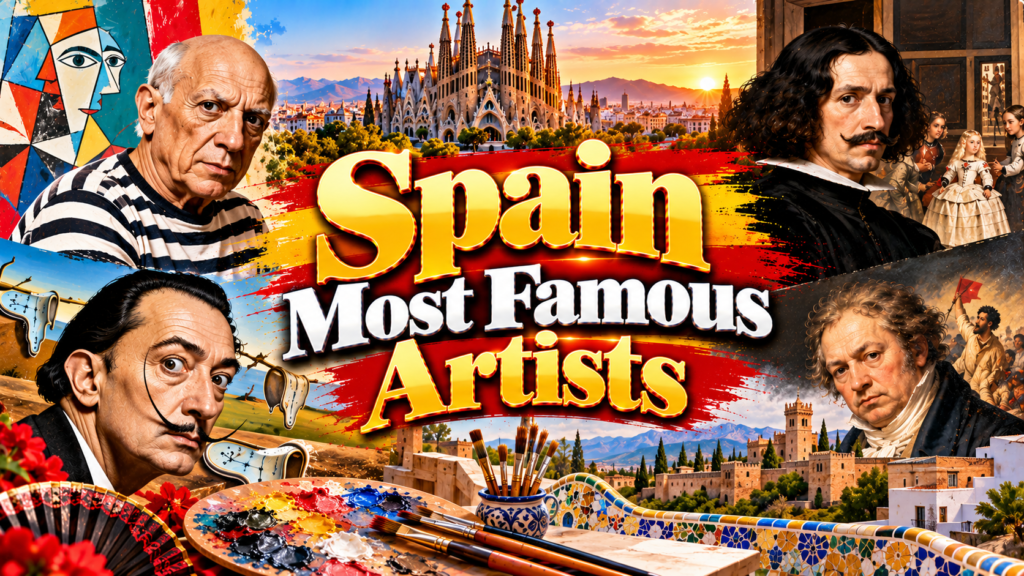
His most famous project is the Sagrada Família in Barcelona, a monumental basilica whose construction began in 1882 and continued long after his death in 1926. The building is celebrated for its elaborate façades, towering structures, and symbolic decorative elements.
Other important works include Park Güell, Casa Batlló, and Casa Milà. Each demonstrates Gaudí’s distinctive approach to integrating architecture, sculpture, craftsmanship, and landscape.
Gaudí frequently studied natural forms such as trees, bones, shells, and plant structures. These observations informed his approach to both decoration and engineering.
His work has had a lasting influence on architecture and continues to attract visitors from around the world. Several of his creations are recognized as UNESCO World Heritage properties.
What Other Famous Spanish Artists Should Art Lovers Know?
Beyond the most internationally recognized names, Spain has produced many other artists whose contributions deserve attention.
1. Juan Gris
Juan Gris was born in Madrid in 1887 and became an important figure in Cubism. His paintings frequently combine geometric shapes, carefully arranged objects, and balanced colors. Although he spent much of his career in France, his work remains an important part of Spain’s contribution to modern art.
2. Remedios Varo
Remedios Varo was a Spanish-born Surrealist painter born in 1908. She developed an imaginative style featuring mysterious figures, scientific symbolism, dreamlike architecture, and fantastical narratives. After leaving Europe during the upheavals of the twentieth century, she settled in Mexico, where she produced many of her best-known works.
3. Maruja Mallo
Maruja Mallo was a Spanish painter associated with the avant-garde movements of the twentieth century. Born in 1902, she experimented with Surrealism, geometric forms, and representations of modern society. Her career is also important to the history of women in Spanish art.
4. Eduardo Chillida
Eduardo Chillida was a Basque sculptor born in San Sebastián in 1924. He became famous for monumental sculptures made from materials including iron, steel, and stone. His work explores space, balance, weight, and the relationship between solid forms and empty spaces.
5. Antoni Tàpies
Antoni Tàpies was a Catalan artist born in Barcelona in 1923. He became internationally known for abstract paintings and mixed-media works that incorporated sand, fabric, scratches, and other textured materials. His art explored memory, materiality, identity, and the expressive possibilities of ordinary surfaces.
These artists demonstrate the diversity of Spain’s artistic heritage, extending from traditional painting to sculpture, experimental abstraction, and imaginative visual storytelling.
What Are the Most Famous Artworks Created by Spanish Artists?
Spain’s artistic legacy includes numerous masterpieces that have influenced museums, artists, scholars, and audiences around the world.
Some particularly important works include:
- Guernica by Pablo Picasso: A monumental anti-war painting that responds to the suffering caused by the Spanish Civil War.
- The Persistence of Memory by Salvador Dalí: A Surrealist masterpiece featuring melting clocks in an unusual landscape.
- Las Meninas by Diego Velázquez: A complex royal portrait celebrated for its composition and exploration of perspective.
- The Third of May 1808 by Francisco Goya: A dramatic depiction of wartime executions and human suffering.
- The Burial of the Count of Orgaz by El Greco: A religious painting combining earthly figures with a visionary heavenly scene.
- The Farm by Joan Miró: A detailed and symbolically rich depiction of rural life that helped establish Miró’s distinctive modern style.
- Sad Inheritance! by Joaquín Sorolla: A powerful seaside painting that combines social themes with luminous natural effects.
- The Persistence of Memory, along with other Surrealist works by Dalí: Examples of how dreams and unexpected associations can challenge conventional ideas about reality.
These masterpieces differ greatly in subject, technique, and historical context. Together, they reveal how Spanish artists have repeatedly expanded the possibilities of visual expression.
Where Can You See Famous Spanish Artworks Today?
Spain offers some of the world’s most important museums for anyone interested in the country’s artistic heritage. Madrid is an especially valuable destination because it contains several major collections within a relatively small area.
The Prado Museum in Madrid is renowned for works by Velázquez, Goya, El Greco, and other European masters. Its collections provide an exceptional introduction to Spanish royal patronage, religious painting, and the achievements of the Spanish Golden Age.
The Museo Reina Sofía, also in Madrid, is a leading destination for modern and contemporary art. It houses Picasso’s Guernica and works by other major twentieth-century artists.
The Museu Picasso Barcelona offers an extensive collection that traces Picasso’s artistic development, including his early work and formative years.
The Dalí Theatre-Museum in Figueres, Catalonia, explores Dalí’s imaginative universe through paintings, installations, and theatrical displays. It is one of the most distinctive museums dedicated to a single artist.
Art lovers can also explore the Joan Miró Foundation in Barcelona, which presents works by Miró and highlights his contributions to modern art.
For architecture enthusiasts, Barcelona’s Sagrada Família, Park Güell, Casa Batlló, and Casa Milà offer opportunities to experience Gaudí’s extraordinary artistic vision firsthand.
Visiting these museums and landmarks provides a deeper understanding of the historical settings, materials, and cultural influences that shaped Spanish art.
How Have Spanish Artists Influenced Modern and Contemporary Art?
Spanish artists have played a central role in the development of international art movements. Their influence extends beyond national borders, affecting painting, sculpture, architecture, design, photography, and popular culture.
Picasso’s Cubism transformed traditional ideas about perspective and representation. Dalí’s Surrealist paintings introduced striking visual metaphors that continue to influence illustration, film, advertising, and contemporary imagery. Goya’s depictions of war and political violence established powerful examples of socially engaged art.
Velázquez’s approach to portraiture and light influenced later European painters, while Miró’s simplified symbols and abstract forms contributed to the development of modern visual languages. Gaudí’s organic architecture inspired generations of architects and designers interested in combining engineering with artistic imagination.
Spanish artists have also demonstrated that cultural identity can coexist with experimentation. Their works frequently draw upon local landscapes, religious traditions, folklore, historical events, and regional languages while engaging with international artistic movements.
In contemporary art, this legacy remains visible in the continued exploration of identity, memory, politics, abstraction, and unconventional materials.
The importance of Spanish art therefore lies not only in its famous masterpieces but also in its continuing ability to inspire new generations of creative thinkers.
Why Should You Explore the Work of Spain’s Most Famous Artists?
Exploring Spanish artists offers an opportunity to discover how art reflects human experience across different historical periods. Their paintings, sculptures, and buildings reveal changing attitudes toward religion, power, identity, war, nature, and imagination.
From Picasso’s innovative Cubist compositions to Dalí’s dreamlike landscapes, from Goya’s disturbing depictions of conflict to Sorolla’s sunlit beaches, Spanish art encompasses an extraordinary range of emotions and ideas.
Studying these artists also helps explain the development of major international movements. Their innovations challenged traditional artistic expectations and opened new possibilities for representing the world.
Whether you are a student, a traveler, a history enthusiast, or an art lover, learning about Spain’s artistic heritage can deepen your appreciation of European culture. Visiting museums, studying individual masterpieces, and exploring the buildings associated with famous artists can make the experience even more rewarding.
Conclusion: Which Spanish Artists Have Left the Greatest Legacy?
The most famous artists from Spain have shaped the history of art through their originality, technical skill, and willingness to experiment. Pablo Picasso revolutionized modern painting, Salvador Dalí made Surrealism internationally recognizable, Francisco Goya explored the darker realities of human experience, and Diego Velázquez established new standards for portraiture and composition.
Joan Miró expanded the possibilities of abstraction, El Greco developed an expressive and spiritual visual language, Joaquín Sorolla captured the brilliance of Mediterranean light, and Antoni Gaudí transformed architecture through organic forms and imaginative design.
Other artists, including Zurbarán, Murillo, Juan Gris, Remedios Varo, Eduardo Chillida, and Antoni Tàpies, further demonstrate the depth and variety of Spain’s creative traditions.
Ultimately, there is no single measure of greatness in art. Each artist contributed a distinctive perspective, shaped by personal experience and historical circumstances. Their works continue to be studied, exhibited, and celebrated because they communicate ideas and emotions that remain meaningful across generations.
Discovering the most famous artists from Spain is therefore more than an introduction to celebrated names. It is a journey through centuries of creativity, cultural exchange, and artistic transformation that continues to influence the world today.
Read More – How To Connects With the Europe Global Economy