
Understanding Workplace Traditions, Employee Rights and Work-Life Balance: Job Work Culture in Europe
Job work culture in Europe is widely recognised for its emphasis on work-life balance, employee well-being, professional development, workplace equality, and employment rights. European countries have developed different workplace traditions shaped by their economies, cultural values, labour laws, and social systems. While some countries encourage flexible working arrangements and relaxed office environments, others focus on punctuality, structured schedules, teamwork, and professional discipline.
For international professionals, understanding European workplace culture can be an important step towards building a successful career. Whether someone is looking for employment in Germany, France, the Netherlands, Spain, Italy, Sweden, or another European country, knowing how workplaces operate can help them adapt to professional expectations.
But what makes working in Europe different? How do European companies manage working hours, employee benefits, salaries, holidays, and workplace relationships? Exploring these questions provides a better understanding of professional life across the continent.
1. What Are the Main Characteristics of Job Work Culture in Europe?
European work culture combines professionalism with an emphasis on employee satisfaction and personal freedom. Many organisations recognise that productive employees need a healthy balance between professional responsibilities and personal life.
Although workplace practices differ between countries and industries, several common characteristics can be found across Europe.
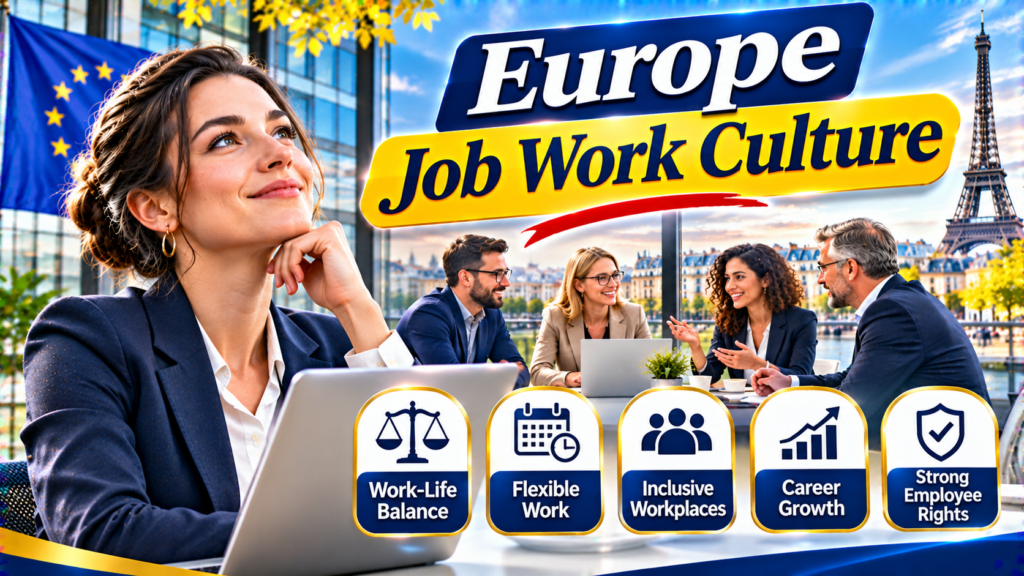
Some important features include:
- Work-life balance: Employees are generally encouraged to maintain a healthy separation between professional and personal responsibilities.
- Employee rights: Employment laws provide protections relating to working conditions, holidays, workplace safety, and discrimination.
- Professionalism: Reliability, accountability, punctuality, and effective communication are valued.
- Workplace equality: Many organisations promote equal opportunities and inclusive working environments.
- Team collaboration: Employees are encouraged to share ideas, solve problems, and contribute to organisational goals.
- Flexible working: Remote and hybrid working arrangements are increasingly common in many sectors.
- Career development: Training, professional education, and skill development are important parts of employment.
These characteristics contribute to Europe’s diverse but generally employee-conscious professional environment.
2. How Many Hours Do Employees Work in Europe?
Working hours are an important part of European employment culture. Many European countries follow structured working schedules, although actual working hours depend on the country, profession, employment contract, and organisation.
The European Union’s Working Time Directive establishes important minimum protections. It generally limits average weekly working time, including overtime, to 48 hours over the applicable reference period. It also provides minimum daily and weekly rest periods.
In many European offices, full-time employment commonly involves approximately 35 to 40 hours per week.
Some examples of working arrangements include:
- Germany: Many full-time positions follow schedules of approximately 35 to 40 hours per week.
- France: The standard statutory working week is 35 hours, although overtime and different contractual arrangements exist.
- Netherlands: Part-time employment is particularly common, and flexible schedules are widely used.
- Spain: Working arrangements vary by sector and collective agreements, with many full-time positions following schedules close to 40 hours.
- Sweden: Many employees work around 40 hours per week under common full-time arrangements.
Employees should always check their employment contracts and national labour regulations because working-time rules differ across European countries.
3. Why Is Work-Life Balance Important in European Work Culture?
Work-life balance is one of the most recognised features of employment culture in several European countries. Many employers understand that employees need time for family, personal interests, education, travel, and relaxation.
Unlike workplace environments that measure commitment primarily through long office hours, many European organisations focus on performance, efficiency, and the quality of completed work.
Work-life balance is supported through several practices:
- Regulated working hours and rest periods.
- Paid annual leave.
- Parental and family-related leave.
- Flexible working arrangements where available.
- Remote and hybrid employment options.
- Workplace health and well-being initiatives.
Countries such as Denmark, Sweden, the Netherlands, and Norway are often associated with employee-friendly workplace practices.
However, work-life balance is not identical everywhere. Employees in finance, healthcare, hospitality, technology, and other demanding industries may experience longer or less predictable schedules.
4. What Are the Workplace Rules and Professional Expectations in Europe?
European workplaces generally value professionalism, responsibility, mutual respect, and clear communication.
Employees are expected to understand their responsibilities, complete assignments within agreed deadlines, and communicate effectively with colleagues and managers.
Some common workplace expectations include:
Punctuality: Arriving on time for meetings, appointments, and scheduled work is important in many European countries.
Professional communication: Employees are expected to communicate clearly, respectfully, and appropriately.
Accountability: Taking responsibility for assigned tasks and delivering quality work are important professional qualities.
Teamwork: Collaboration and sharing knowledge are encouraged in many organisations.
Independence: Employees may be expected to manage their responsibilities without constant supervision.
Respect for diversity: Working with colleagues from different nationalities, cultures, and backgrounds is common in international European organisations.
Understanding these expectations can help international professionals build positive workplace relationships.
5. How Do European Companies Treat Their Employees?
Employee treatment is an important aspect of European employment culture. Many European countries have established labour laws, collective bargaining systems, and workplace policies intended to protect employees.
Companies may provide several forms of support, depending on national regulations and employment contracts.
These include:
- Fair and transparent employment agreements.
- Paid annual leave and public holidays.
- Workplace health and safety protections.
- Protection against unlawful discrimination.
- Social security contributions and relevant insurance arrangements.
- Opportunities for training and professional development.
- Maternity, paternity, and parental leave rights.
European Union legislation provides a common framework for certain employment protections, while individual countries establish additional rules.
The quality of employee treatment also depends on company leadership, organisational culture, industry practices, and the enforcement of employment laws.
6. What Is the Role of Employee Benefits in European Work Culture?
Employee benefits play an important role in attracting and retaining skilled professionals across Europe.
In addition to salaries, employees may receive benefits that support their financial security, health, family responsibilities, and professional development.
Common employment benefits include:
- Paid annual holidays.
- Public holiday entitlements.
- Pension contributions.
- Healthcare and social security coverage under national systems.
- Parental and family-related leave.
- Paid sick leave, subject to national rules.
- Professional training opportunities.
- Transport or meal allowances in some organisations.
- Flexible and remote working options.
The exact benefits vary considerably between countries and employers. Some benefits are guaranteed by national legislation, while others are offered voluntarily by companies.
For international job seekers, understanding the complete benefits package is just as important as comparing monthly salaries.
7. How Does Work Culture Differ Between European Countries?
Europe does not have one uniform workplace culture. Each country has its own professional traditions, communication styles, management approaches, and employment practices.
Understanding these differences can help professionals adapt to different working environments.
Germany: Why Is Discipline Important in German Work Culture?
German workplace culture is often associated with punctuality, organisation, efficiency, and structured communication.
Employees are generally expected to arrive on time, respect professional commitments, and complete tasks according to agreed standards.
Common characteristics include:
- Strong emphasis on planning and preparation.
- Clear responsibilities and professional boundaries.
- Direct and structured communication.
- Focus on efficiency and quality.
- Respect for technical knowledge and expertise.
France: How Does French Workplace Culture Balance Professionalism and Personal Life?
French workplace culture combines professional formality with a strong appreciation for personal time and social life.
Employees often work within structured schedules, while labour laws provide protections concerning working time, holidays, and employee rights.
Important characteristics include:
- Formal professional communication.
- Respect for expertise and qualifications.
- Importance of workplace discussions.
- Strong employee representation in many sectors.
- Attention to holidays and personal time.
Netherlands: Why Is Dutch Workplace Culture Known for Flexibility?
The Netherlands is widely associated with flexible working arrangements, direct communication, and relatively flat organisational structures.
Many companies encourage employees to express opinions and contribute to workplace decisions.
Common features include:
- Flexible and part-time working arrangements.
- Open communication with managers.
- Emphasis on collaboration.
- Work-life balance.
- Relatively informal workplace relationships in many organisations.
Sweden: How Does Swedish Work Culture Promote Equality?
Swedish workplace culture is often associated with equality, cooperation, transparency, and employee participation.
Many organisations encourage open discussions and maintain relatively limited hierarchies.
Some important features include:
- Gender equality initiatives.
- Family-friendly employment policies.
- Collaborative decision-making.
- Flexible work arrangements.
- Respect for employees’ personal lives.
Spain: What Makes Spanish Workplace Culture Different?
Spanish workplace culture combines professional responsibilities with social interaction and relationship-building.
Working schedules can differ from those in northern Europe, particularly in certain traditional sectors and regions.
Common characteristics include:
- Importance of professional relationships.
- Teamwork and communication.
- Respect for workplace hierarchy in some organisations.
- Regional differences in working schedules.
- Growing adoption of flexible and remote work.
Italy: How Does Italian Workplace Culture Emphasise Relationships?
Italian workplaces often place importance on personal relationships, communication, professional reputation, and industry-specific traditions.
The working environment varies between large international companies, family businesses, public institutions, and small enterprises.
Some characteristics include:
- Importance of professional networks.
- Relationship-based communication.
- Respect for experience and expertise.
- Strong regional differences.
- Growing interest in digital and flexible employment.
8. Are European Workplaces Formal or Informal?
European workplaces can be either formal or informal, depending on the country, company, industry, and management style.
Traditional industries, financial institutions, government organisations, and legal firms may maintain formal communication and professional dress codes.
In contrast, technology companies, creative agencies, and startups often encourage relaxed communication, casual clothing, and flexible working environments.
For example, employees in some German financial institutions may follow formal office traditions, while employees in Dutch or Scandinavian technology companies may experience more informal workplace relationships.
The most important approach for newcomers is to observe company expectations and adapt accordingly.
9. How Important Is Gender Equality in European Workplace Culture?
Gender equality is an important part of employment policies and workplace discussions across Europe.
European Union laws establish protections against gender discrimination and promote equal treatment in employment. Many countries also have national policies addressing pay transparency, parental leave, career opportunities, and workplace inclusion.
Companies increasingly focus on creating environments where employees have equal opportunities regardless of gender.
Important areas include:
- Equal treatment in recruitment and promotion.
- Protection against workplace discrimination.
- Fair employment opportunities.
- Parental leave policies.
- Measures addressing the gender pay gap.
- Leadership development and workplace inclusion.
Despite progress, challenges remain. Gender pay differences, unequal representation in senior positions, and barriers to career advancement continue to be discussed across European countries.
10. What Is the Importance of Diversity and Inclusion in European Workplaces?
European workplaces bring together people from different nationalities, languages, cultures, educational backgrounds, and professional experiences.
International companies often depend on multicultural teams to develop products, serve customers, and operate across different markets.
Diversity and inclusion policies aim to ensure that employees feel respected and have equal opportunities to contribute.
Many organisations focus on:
- Recruiting employees from diverse backgrounds.
- Providing equal professional opportunities.
- Preventing discrimination and harassment.
- Encouraging cultural understanding.
- Supporting employees with disabilities.
- Creating respectful communication environments.
For international professionals, cultural awareness and the ability to work with people from different backgrounds are valuable career skills.
11. Can Employees Work Remotely in Europe?
Remote working has become an important part of European employment culture, particularly following the expansion of digital technologies and changes in workplace practices.
Many organisations offer hybrid arrangements in which employees divide their time between home and the office.
Remote work is particularly common in sectors where tasks can be completed digitally.
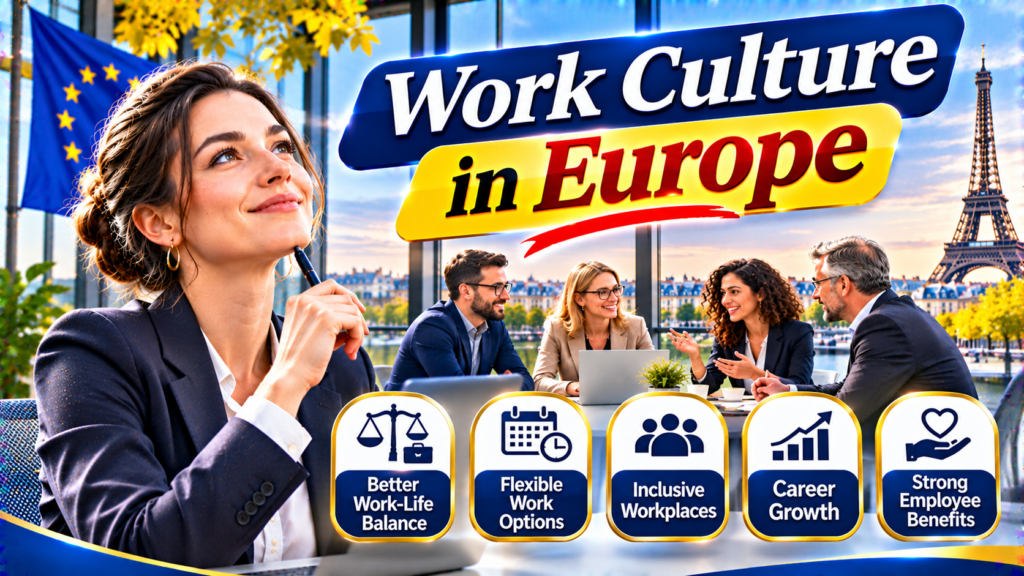
These industries include:
- Information technology.
- Digital marketing.
- Software development.
- Graphic design.
- Finance and accounting.
- Customer support.
- Consulting.
- Content creation and communications.
However, not every profession offers remote working opportunities. Healthcare, construction, manufacturing, hospitality, transportation, and retail often require employees to work at specific locations.
Remote work policies also depend on employment contracts, tax rules, immigration conditions, and national regulations.
12. How Do Salaries and Wages Differ Across Europe?
Salaries across Europe vary according to the country, profession, qualifications, work experience, and economic conditions.
Countries such as Switzerland, Luxembourg, Denmark, and Norway are often associated with relatively high salary levels. However, living costs in these locations can also be considerably higher.
Eastern and Southern European countries may offer lower average salaries in some sectors, although housing, transportation, and everyday expenses may also be lower in certain locations.
Factors affecting salaries include:
- Professional qualifications.
- Years of work experience.
- Industry and job responsibilities.
- Location and cost of living.
- Company size and financial performance.
- Language skills.
- Labour market demand.
Professionals should compare net salaries, taxation, housing costs, healthcare arrangements, and employee benefits before accepting a job offer.
A higher gross salary does not always mean a better financial lifestyle.
13. What Role Does Education and Professional Development Play in European Work Culture?
Education and continuous learning are important for career growth in many European industries.
Employers increasingly value professionals who update their knowledge, improve technical abilities, and adapt to changing business requirements.
Companies may support employee development through:
- Professional training programmes.
- Industry certifications.
- Internal workshops.
- Leadership development.
- Mentoring opportunities.
- Language courses.
- Digital skills training.
- Further education support.
The growing importance of artificial intelligence, automation, sustainability, and digital transformation has increased demand for employees with modern technical and analytical skills.
Continuous learning can help professionals remain competitive in Europe’s changing employment market.
14. What Challenges Do International Employees Face When Working in Europe?
Working in Europe can provide valuable professional opportunities, but international employees may also face several challenges when adapting to a new environment.
Some common difficulties include:
Language barriers: English is widely used in international business, but local language skills may be necessary for many jobs and everyday activities.
Cultural differences: Communication styles, management practices, and workplace expectations can vary between countries.
Recognition of qualifications: Some regulated professions require formal recognition of foreign educational qualifications.
Visa and work permits: Non-EU nationals generally need the appropriate immigration permission to work in a European country.
Cost of living: Housing, transportation, food, and other expenses can be high in major European cities.
Professional networking: Building relationships and finding career opportunities may take time.
Administrative procedures: Employment registration, taxation, residence permits, and social security arrangements can involve additional paperwork.
Preparing in advance and researching national employment regulations can make the transition easier.
15. What Skills Are Important for Building a Successful Career in Europe?
Employers across Europe look for candidates who combine professional expertise with strong communication, problem-solving, and interpersonal abilities.
Although specific requirements differ between industries, several skills can improve employment opportunities.
Important skills include:
- Communication: Sharing ideas clearly and working effectively with colleagues.
- Adaptability: Adjusting to new technologies, responsibilities, and professional environments.
- Teamwork: Collaborating with colleagues from different backgrounds.
- Problem-solving: Finding practical solutions to workplace challenges.
- Digital literacy: Using modern workplace technologies and digital tools.
- Time management: Completing responsibilities efficiently and meeting deadlines.
- Language proficiency: Communicating effectively in English and, where required, local languages.
- Leadership: Taking initiative and supporting team performance.
A combination of technical qualifications and interpersonal skills can help professionals build long-term careers.
16. How Is Technology Changing Job Work Culture in Europe?
Technology is transforming European workplaces by changing how companies communicate, manage employees, deliver services, and organise professional responsibilities.
Artificial intelligence, automation, cloud computing, and digital collaboration tools are becoming increasingly important across industries.
Some major workplace changes include:
- Increased use of artificial intelligence in business operations.
- Greater demand for digital and technical skills.
- Expansion of remote and hybrid employment.
- Online recruitment and virtual interviews.
- Digital employee training.
- Automated administrative processes.
- Improved international collaboration.
These developments are creating new employment opportunities while changing the skills required for existing jobs.
Professionals who remain open to learning and technological change may be better prepared for future career opportunities.
17. What Are the Future Trends in European Workplace Culture?
European workplace culture will continue to evolve as businesses respond to technological innovation, demographic changes, environmental priorities, and changing employee expectations.
Several trends are likely to influence the future of employment.
Artificial intelligence and automation: Companies will increasingly use intelligent systems to improve productivity and business operations.
Flexible working arrangements: Hybrid and remote working may remain important in occupations where such arrangements are practical.
Employee well-being: Mental well-being, workplace safety, and healthy working environments will continue to receive attention.
Green employment: The transition towards renewable energy and sustainable industries is expected to create new professional opportunities.
Skills-based recruitment: Employers may place greater emphasis on practical skills, experience, and professional abilities.
Workplace diversity: Inclusion and equal opportunities will remain important subjects in corporate policies.
Lifelong learning: Continuous professional development will become increasingly valuable as industries change.
These developments indicate that European workplaces are moving towards more technology-driven, adaptable, and skills-focused employment environments.
Conclusion: Why Is Understanding Job Work Culture in Europe Important?
Job work culture in Europe reflects a combination of professional discipline, employee protection, workplace equality, technological development, and work-life balance. Although employment practices differ between countries, many European organisations place considerable importance on creating productive and respectful working environments.
From Germany’s structured professional traditions to the Netherlands’ flexible working arrangements and Sweden’s emphasis on equality, every country offers a distinctive employment experience.
For international professionals, understanding local workplace expectations, employment rights, communication styles, and cultural differences can make a significant difference when starting a career in Europe.
As technology, globalization, and changing employee expectations continue to reshape the professional landscape, European work culture will keep evolving. Employees who develop relevant skills, remain adaptable, and understand different workplace traditions will be better positioned to explore opportunities across the continent.
Ultimately, a successful career in Europe is not only about finding the right job. It is also about understanding the workplace, respecting cultural differences, maintaining professional relationships, and achieving a healthy balance between work and personal life.
Read More – Most Famous Artists from Germany