
Ultimate Guide To Know How Is Digital Transformation Changing Europe Businesses?
Digital transformation is changing the way businesses operate, compete and grow across Europe. From small family-owned companies to multinational corporations, organisations are increasingly adopting digital technologies to improve efficiency, enhance customer experiences and discover new opportunities. Artificial intelligence (AI), cloud computing, automation, big data, e-commerce and digital payment systems are becoming important parts of modern business strategies.
Across the Europe business landscape, technology is no longer simply a supporting tool. It is becoming a major driver of innovation, productivity and competitiveness. Companies are using digital solutions to simplify operations, reach international customers, manage employees remotely and respond more effectively to changing market demands.
But how exactly is digital transformation changing Europe businesses? What technologies are making the biggest difference? How are small businesses adapting to the digital economy, and what challenges must companies overcome?
Understanding these developments helps explain why digital transformation is becoming essential for the future of Europe industries.
1. What Does Digital Transformation Mean for Europe Businesses?
Digital transformation refers to the integration of digital technologies into different areas of business operations. It involves changing traditional processes, business models and customer interactions through technology.
For Europe companies, digital transformation means moving beyond basic computerization and adopting connected systems that improve decision-making, productivity and business performance.
For example, a traditional retail company may introduce an e-commerce platform, digital inventory management, automated customer support and online payment solutions. Similarly, a manufacturing business may use smart sensors, robotics and artificial intelligence to improve production processes.
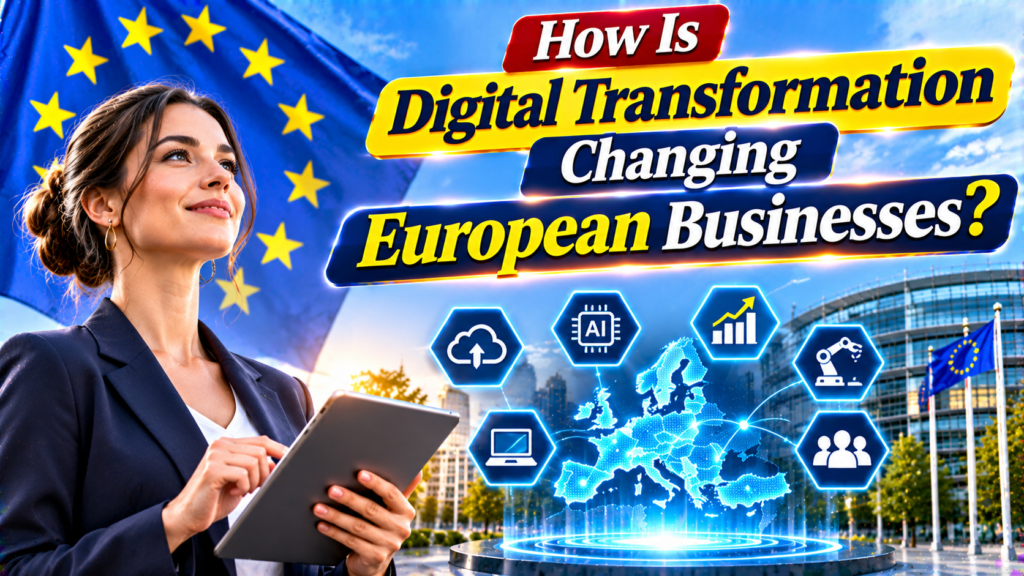
Digital transformation generally involves:
- Business automation: Using software and machines to reduce repetitive manual tasks.
- Artificial intelligence: Applying intelligent systems to analyse information and support decisions.
- Cloud computing: Storing and accessing business information through secure online infrastructure.
- Data analytics: Using business data to identify trends and understand customer behaviour.
- Digital communication: Connecting employees, customers and business partners through online platforms.
- Cybersecurity: Protecting digital systems, business information and customer data.
These technologies allow Europe businesses to become more flexible, efficient and competitive in an increasingly digital marketplace.
2. Why Is Digital Transformation Becoming Important for Europe Companies?
Europe businesses operate in a highly competitive environment. Globalisation, changing customer expectations, technological developments and economic uncertainty are encouraging companies to modernise their operations.
Customers increasingly expect convenient digital services, faster communication, personalised recommendations and secure online transactions. Businesses that cannot meet these expectations may struggle to compete with digitally advanced organisations.
Digital transformation also helps companies respond to operational challenges, including rising costs, skills shortages and supply chain disruptions.
Some major reasons behind its growing importance include:
- Improved productivity: Digital tools help employees complete tasks more efficiently.
- Better customer experiences: Companies can offer faster and more personalised services.
- International expansion: Online platforms help businesses reach customers across borders.
- Lower operational costs: Automation can reduce unnecessary expenses.
- Faster decision-making: Real-time information supports more informed business decisions.
- Greater flexibility: Cloud-based systems make it easier to adapt to changing business conditions.
Digital transformation is therefore becoming an important strategy for companies seeking long-term growth in Europe.
3. How Is Artificial Intelligence Transforming Europe Businesses?
Artificial intelligence is one of the most influential technologies driving digital transformation across Europe. Companies in industries such as banking, healthcare, manufacturing, retail, transportation and professional services are exploring AI-powered solutions to improve efficiency and create new business opportunities.
AI allows organisations to process large amounts of information, identify patterns, automate tasks and support complex decisions. Europe businesses are increasingly using these capabilities to improve both internal operations and customer services.
For example, financial institutions can use AI to identify suspicious transactions, while retailers can analyse shopping behaviour to recommend products that customers may prefer.
Some important applications of AI in Europe businesses include:
- Customer service: AI chatbots provide instant answers to common customer questions.
- Financial analysis: Intelligent systems help identify financial patterns and potential risks.
- Marketing: AI tools support personalised advertising and customer targeting.
- Manufacturing: Predictive systems help identify equipment problems before breakdowns occur.
- Human resources: AI-powered platforms assist with recruitment administration and workforce planning.
However, businesses must also consider responsible AI practices, data protection and the Europe Union’s AI Act. As AI adoption increases, transparency, accountability and human oversight are becoming important considerations.
4. How Is Automation Improving Business Productivity in Europe?
Automation is changing how Europe businesses manage everyday activities. Tasks that previously required considerable time and manual effort can now be completed through software, robotics and automated systems.
Manufacturing companies are among the major adopters of automation. Industrial robots can perform repetitive production tasks, while automated quality-control systems help identify product defects.
Automation is also becoming increasingly common in offices, logistics companies, warehouses and financial departments.
For example, businesses can automate:
- Invoice processing and payment reminders.
- Employee attendance and payroll administration.
- Customer enquiries and appointment scheduling.
- Inventory tracking and stock management.
- Order processing and delivery notifications.
- Data entry and routine reporting.
How does this benefit Europe companies? Automation reduces repetitive workloads, improves consistency and allows employees to focus on activities that require creativity, communication and problem-solving.
For small and medium-sized enterprises (SMEs), affordable automation software can provide access to capabilities that were previously associated with larger organisations.
5. How Is Cloud Computing Changing Europe Business Operations?
Cloud computing is helping Europe businesses move away from traditional IT infrastructure towards flexible digital environments.
Instead of depending entirely on physical servers and locally stored information, companies can use cloud platforms to store data, manage applications and access business systems through the internet.
This technology is particularly valuable for businesses operating across different Europe countries.
Employees can collaborate on shared documents, access important information and communicate with colleagues without being physically present in the same office.
Major benefits of cloud computing include:
- Cost efficiency: Companies can reduce the need to purchase and maintain extensive physical infrastructure.
- Remote accessibility: Employees can access authorised business applications from different locations.
- Scalability: Businesses can increase or reduce computing resources according to their requirements.
- Collaboration: Teams can work together through shared digital platforms.
- Business continuity: Cloud services can support backup and recovery strategies.
Europe organisations are also paying attention to data sovereignty, privacy requirements and the General Data Protection Regulation (GDPR) when selecting cloud service providers.
The growing use of cloud technology is making business operations more connected and adaptable.
6. How Is E-Commerce Transforming Europe Retail Businesses?
E-commerce has fundamentally changed the Europe retail industry. Consumers can now purchase products from local and international sellers without visiting physical stores.
Online marketplaces, independent shopping websites and mobile applications are creating new opportunities for businesses to reach customers.
Small retailers can establish online stores and sell products beyond their immediate geographical markets. Meanwhile, established brands are combining physical stores with digital shopping experiences.
Digital transformation is changing retail through several developments:
- Online shopping platforms and mobile commerce.
- Digital wallets and contactless payments.
- Personalised product recommendations.
- Automated order tracking and delivery updates.
- Digital inventory and warehouse management.
- Customer reviews and online engagement.
Another important development is omnichannel retailing. This approach connects online and offline shopping experiences.
For instance, customers may discover a product through social media, purchase it through a website and collect it from a nearby store.
Europe retailers are also investing in convenient return processes, secure payment systems and improved delivery services to build customer confidence.
7. How Are Digital Payments Changing Europe Businesses?
Digital payment technology is making financial transactions faster and more convenient across Europe.
Traditional cash-based transactions are increasingly being complemented by contactless cards, mobile wallets, online banking and instant payment solutions.
Businesses benefit from digital payments because they can simplify checkout processes, reduce cash-handling requirements and manage transactions more efficiently.
Some important developments include:
- Contactless card payments in retail stores.
- Mobile payment applications.
- Online payment gateways.
- Digital invoicing and accounting.
- Instant bank transfers.
- Cross-border payment solutions.
The Europe Union’s efforts to develop instant euro payments are also supporting the modernisation of the financial ecosystem.
For businesses operating internationally, efficient digital payment systems can make it easier to serve customers and suppliers in different countries.
Nevertheless, companies must maintain strong payment security measures to protect financial information and prevent fraud.
8. How Is Digital Transformation Changing Europe Manufacturing?
Europe manufacturing is experiencing significant technological changes through smart factories, industrial automation and connected production systems.
The concept of Industry 4.0 is particularly important because it combines digital technologies with traditional manufacturing processes.
Factories are increasingly adopting sensors, robotics, artificial intelligence, cloud platforms and the Internet of Things (IoT).
These technologies allow machines and systems to exchange information, monitor production and identify operational problems.
For example, smart sensors can monitor machine temperatures and performance. If the system identifies unusual activity, maintenance teams can investigate before a major breakdown occurs.
Important developments in digital manufacturing include:
- Smart production facilities.
- Industrial robotics and automation.
- Predictive maintenance.
- Digital twins and virtual simulations.
- Real-time production monitoring.
- AI-powered quality inspection.
- Connected supply chain management.
Germany, France, Italy and other Europe manufacturing economies have significant opportunities to benefit from these developments.
Digital manufacturing can help companies improve product quality, reduce waste and respond more effectively to changing customer requirements.
9. How Is Digital Transformation Supporting Small and Medium-Sized Enterprises in Europe?
Small and medium-sized enterprises are an important part of the Europe economy. Digital transformation is helping these businesses compete with larger companies by providing access to affordable technologies and online markets.
In the past, advanced business technology often required substantial investment. Today, SMEs can access cloud software, digital marketing tools, online accounting systems and e-commerce platforms through flexible subscription-based services.
For example, a small Europe clothing company can use an online store to reach international customers, cloud accounting software to manage finances and social media platforms to promote its products.
Digital tools can support smaller businesses through:
- Affordable customer relationship management systems.
- Online advertising and digital marketing.
- Cloud-based accounting and invoicing.
- Website development and e-commerce.
- Digital inventory management.
- Online collaboration and communication.
- AI-powered business assistance.
However, SMEs may face difficulties related to investment, technical expertise and cybersecurity.
Government programmes, digital innovation hubs and Europe funding initiatives can help smaller businesses develop their digital capabilities.
10. How Is Digital Transformation Changing the Europe Banking Industry?
The banking industry is undergoing a major digital transformation as customers increasingly prefer online financial services.
Traditional banking services are now supported by mobile applications, internet banking, digital identification and automated financial systems.
Customers can transfer money, monitor accounts, apply for financial products and manage transactions without regularly visiting physical branches.
Europe banks are also exploring artificial intelligence, blockchain-based applications, advanced analytics and automated compliance systems.
Some major changes include:
- Mobile banking and online account management.
- AI-powered fraud detection.
- Digital customer verification.
- Automated financial reporting.
- Personalised banking services.
- Faster international payment processing.
- Improved digital customer support.
Fintech companies are also introducing innovative financial products and challenging traditional banking models.
At the same time, financial institutions must comply with strict Europe regulations, protect customer information and maintain reliable cybersecurity systems.
11. How Is Digital Transformation Changing the Europe Workplace?
Digital transformation is changing not only how companies operate but also how employees work.
Remote working, hybrid offices, virtual meetings and cloud-based collaboration have become important features of modern business environments.
Companies can recruit employees from different locations and connect teams through digital communication platforms.
This development has created greater flexibility for some employees while allowing businesses to access wider talent pools.
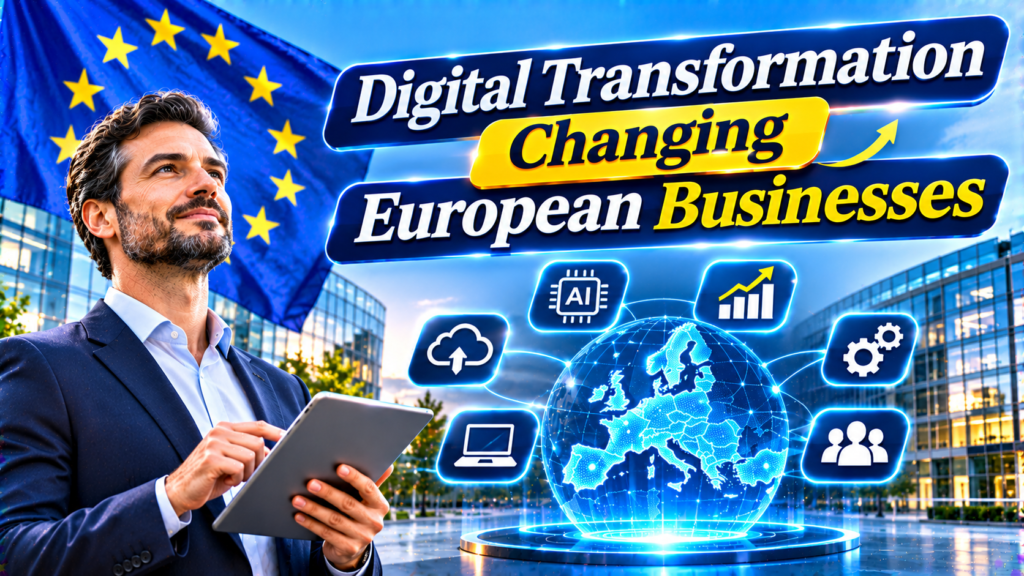
Digital workplaces commonly use:
- Video conferencing applications.
- Online project management platforms.
- Cloud-based document sharing.
- Digital employee management systems.
- Virtual training and learning platforms.
- AI-assisted administrative tools.
However, digital workplaces also require businesses to address employee well-being, data security and communication challenges.
Companies need to provide employees with suitable training so they can confidently use new technologies.
12. How Is Digital Transformation Improving Customer Experiences?
Customer expectations are changing rapidly, and Europe businesses are using digital technology to provide more convenient and personalised experiences.
Consumers increasingly expect companies to offer quick responses, accessible information and smooth interactions across different platforms.
Businesses are using customer relationship management (CRM) software, AI-powered recommendations and data analytics to understand customer preferences.
For example, an online retailer can analyse previous purchases to recommend relevant products. A travel company can use digital platforms to provide personalised booking suggestions and automated travel updates.
Digital transformation improves customer experiences through:
- Faster customer support.
- Personalised recommendations.
- Easy online booking and purchasing.
- Convenient digital payments.
- Real-time order tracking.
- Better communication through multiple channels.
Customer data must be collected and processed responsibly, with appropriate transparency and compliance with privacy regulations.
Companies that combine convenience with customer trust can strengthen their long-term relationships.
13. How Is Digital Transformation Supporting Sustainability in Europe Businesses?
Sustainability is becoming an important part of Europe business strategies. Digital technology is helping companies monitor resource consumption, reduce waste and improve environmental performance.
Smart energy management systems can help businesses understand electricity usage and identify opportunities to improve efficiency.
Manufacturers can use digital monitoring systems to reduce unnecessary production waste, while logistics companies can use route optimisation software to improve transportation efficiency.
Some important applications include:
- Smart energy monitoring.
- Digital supply chain management.
- Paperless office operations.
- Waste reduction through data analytics.
- Efficient transportation planning.
- Smart building management.
- Environmental performance tracking.
Digital technologies can also support businesses in collecting and managing sustainability information.
However, technology itself has an environmental footprint. Data centres, electronic devices and digital infrastructure consume energy and resources. Businesses therefore need to consider the sustainability of their digital investments.
14. What Role Does Cybersecurity Play in Europe Digital Transformation?
As Europe businesses become more dependent on digital systems, cybersecurity is becoming a critical business priority.
Companies manage valuable information, including financial records, customer details, intellectual property and internal communications. Cyberattacks can disrupt operations, damage reputations and create financial losses.
Ransomware, phishing, identity theft and data breaches are among the security threats that businesses must address.
Europe organisations are strengthening cybersecurity through several measures:
- Multi-factor authentication: Adding extra verification steps to protect accounts.
- Data encryption: Protecting sensitive information during storage and transmission.
- Employee awareness: Training workers to recognise suspicious messages and online threats.
- Regular security updates: Keeping software and digital systems protected.
- Data backups: Maintaining recoverable copies of important business information.
- Security monitoring: Identifying unusual activities and responding to potential threats.
The Europe Union’s NIS2 Directive also strengthens cybersecurity requirements for organisations within its scope.
Cybersecurity should not be treated as an optional technology investment. It is an essential part of building a reliable digital business.
15. How Are Europe Businesses Adapting to Data Protection Regulations?
Data protection is an important consideration in Europe’s digital economy.
The General Data Protection Regulation (GDPR) establishes rules concerning the collection, processing, storage and use of personal information.
Businesses operating in Europe must understand their responsibilities when handling customer and employee data.
Digital transformation often involves collecting information through websites, mobile applications, online transactions and customer management systems. This makes responsible data management essential.
Companies should focus on:
- Obtaining appropriate consent where required.
- Explaining how personal information is used.
- Collecting only necessary data.
- Protecting personal information against unauthorised access.
- Respecting individuals’ data protection rights.
- Establishing appropriate data retention policies.
- Working with service providers that meet relevant legal requirements.
Privacy-friendly digital practices can help companies build customer trust while reducing regulatory risks.
16. What Challenges Are Europe Businesses Facing During Digital Transformation?
Although digital transformation offers significant opportunities, implementing new technologies is not always straightforward.
Businesses must overcome financial, technical, organisational and regulatory challenges to achieve successful digital modernisation.
Some common challenges include:
High implementation costs: Advanced technology, software licences, infrastructure and employee training can require considerable investment.
Shortage of digital skills: Companies may struggle to recruit employees with expertise in artificial intelligence, cybersecurity, data analytics and cloud computing.
Resistance to change: Employees and management teams may hesitate to adopt unfamiliar systems or abandon traditional processes.
Cybersecurity threats: Increasing digital connectivity can expose businesses to additional security risks.
Legacy technology: Older systems may not integrate easily with modern software and digital platforms.
Regulatory complexity: Businesses must understand different legal requirements concerning data protection, cybersecurity and emerging technologies.
Digital inequality: Smaller companies and businesses in less digitally developed regions may face difficulties accessing technology and expertise.
Addressing these challenges requires careful planning, investment and long-term commitment.
17. How Can Europe Businesses Successfully Implement Digital Transformation?
Successful digital transformation requires more than purchasing new software or introducing advanced equipment. Businesses need a clear strategy that connects technology investments with their long-term objectives.
Companies should begin by understanding their current operations and identifying areas where digital solutions can deliver measurable improvements.
A practical digital transformation strategy can include the following steps:
- Identify business objectives: Determine whether the priority is productivity, customer experience, cost reduction or international growth.
- Evaluate existing technology: Review current systems and identify operational weaknesses.
- Choose suitable digital tools: Select technologies that address actual business requirements.
- Invest in employee training: Help workers develop the skills needed to use new systems.
- Strengthen cybersecurity: Introduce appropriate security policies and protective technologies.
- Improve data management: Establish reliable systems for collecting, storing and analysing information.
- Measure performance: Monitor productivity, customer satisfaction, operational costs and other relevant indicators.
- Continue improving: Regularly evaluate digital systems and adapt to emerging technologies.
Businesses should avoid adopting technology simply because it is popular. Every digital investment should have a clear purpose and measurable value.
18. Which Europe Industries Are Benefiting Most from Digital Transformation?
Digital transformation is affecting almost every major industry across Europe, although the technologies and benefits vary between sectors.
Some industries experiencing significant digital developments include:
| Industry | Major digital developments |
|---|---|
| Manufacturing | Robotics, smart factories and predictive maintenance |
| Banking | Mobile banking, fintech and AI-based fraud detection |
| Retail | E-commerce, digital payments and personalised shopping |
| Healthcare | Digital records, telemedicine and AI-assisted analysis |
| Transportation | Smart logistics and route optimisation |
| Education | Online learning and digital classrooms |
| Agriculture | Smart farming and precision agriculture |
| Tourism | Online booking and personalised travel services |
| Real estate | Virtual property tours and digital management |
| Energy | Smart grids and intelligent energy monitoring |
These developments demonstrate that digital transformation is not limited to technology companies. It is becoming relevant to traditional industries, service providers and businesses of every size.
19. What Is the Future of Digital Transformation in Europe Businesses?
The future of Europe business will increasingly depend on the ability of companies to adopt emerging technologies and respond to changing market conditions.
Artificial intelligence, advanced robotics, quantum computing, blockchain applications, connected devices and next-generation cloud infrastructure could create new opportunities across different industries.
AI is expected to play an increasingly important role in business planning, customer support, product development and operational management. Meanwhile, connected devices will provide businesses with more detailed information about production, logistics and equipment performance.
Several trends are likely to influence the future of digital transformation in Europe:
- Generative AI: Businesses will explore AI tools for content creation, research and administrative assistance.
- Intelligent automation: More routine business processes could become automated.
- Advanced cybersecurity: Companies will invest in stronger digital protection and threat detection.
- Smart manufacturing: Connected factories will support more efficient production.
- Digital identity: Secure digital identification will simplify certain online services.
- Sustainable technology: Businesses will increasingly evaluate the environmental impact of digital infrastructure.
- Data-driven decision-making: Companies will rely more heavily on analytics to understand markets and improve operations.
Europe businesses will also need to balance innovation with responsible technology use, regulatory compliance and customer trust.
20. Can Digital Transformation Help Europe Businesses Compete Globally?
Yes. Digital transformation can help Europe businesses strengthen their position in international markets by improving efficiency, expanding customer reach and supporting innovation.
Digital platforms allow companies to communicate with international customers, sell products across borders and develop partnerships with businesses in other countries.
Cloud computing and online collaboration tools make it easier for international teams to work together. Meanwhile, advanced analytics can help organisations understand customer preferences in different markets.
Digital transformation can improve global competitiveness through:
- Access to international customers.
- More efficient international supply chains.
- Faster product development.
- Improved customer communication.
- Better business intelligence.
- Increased operational flexibility.
- Opportunities for new digital products and services.
However, technology alone cannot guarantee international success. Companies must also understand local markets, cultural differences, regulations and customer expectations.
Europe businesses that combine digital innovation with strong business strategies will be better positioned to compete in the global economy.
Frequently Asked Questions (FAQs)
Q1. What is digital transformation in Europe businesses?
Ans: Digital transformation in Europe businesses refers to adopting technologies such as artificial intelligence, automation, cloud computing and data analytics to improve operations, customer experiences and business growth.
Q2. Why is digital transformation important for Europe companies?
Ans: It helps Europe companies improve productivity, reduce costs, reach international customers, strengthen competitiveness and respond to changing market expectations.
Q3. Which technologies are driving digital transformation in Europe?
Ans: Artificial intelligence, machine learning, cloud computing, robotics, big data, the Internet of Things, blockchain applications and cybersecurity solutions are among the important technologies.
Q4. How does digital transformation benefit small businesses in Europe?
Ans: It allows small businesses to access affordable software, establish online stores, automate routine tasks, improve customer relationships and reach international markets.
Q5. How is AI changing Europe businesses?
Ans: AI helps companies automate tasks, analyse information, improve customer support, identify business trends and support decision-making.
Q6. What are the biggest challenges of digital transformation?
Ans: Major challenges include high implementation costs, cybersecurity threats, skills shortages, employee resistance, legacy systems and regulatory compliance.
Q7. How does digital transformation improve customer experiences?
Ans: It enables faster customer support, personalised recommendations, convenient online shopping, digital payments and better communication.
Q8. What is the role of cybersecurity in digital transformation?
Ans: Cybersecurity protects business systems, customer information, financial records and digital infrastructure from cyberattacks and unauthorised access.
Q9. Is digital transformation important for Europe manufacturing?
Ans: Yes. Smart factories, robotics, predictive maintenance and connected production systems help manufacturers improve efficiency, product quality and operational performance.
Q10. What is the future of digital transformation in Europe?
Ans: The future will involve greater adoption of AI, intelligent automation, connected industries, advanced cybersecurity, cloud computing and sustainable digital technologies.
Conclusion: Why Is Digital Transformation Essential for the Future of Europe Businesses?
Digital transformation is reshaping Europe businesses by changing how companies manufacture products, deliver services, communicate with customers and manage their operations. Artificial intelligence, automation, cloud computing, e-commerce, digital payments and data analytics are creating opportunities for businesses across different industries.
From multinational corporations to small and medium-sized enterprises, organisations are discovering how technology can improve productivity, reduce operational difficulties and support long-term growth.
However, successful digital transformation requires more than adopting new technologies. Businesses must also invest in employee skills, strengthen cybersecurity, protect customer information and develop strategies that support sustainable innovation.
As Europe continues to develop its digital economy, companies that embrace technological change while maintaining customer trust and responsible business practices will have important opportunities to grow.
Ultimately, digital transformation is not simply about replacing traditional business processes with modern technology. It is about creating smarter, more connected, innovative and competitive Europe businesses for the future. UT replacing traditional business processes with modern technology. It is about creating smarter, more connected, innovative and competitive European businesses for the future.
Read More – What Rights Do European Workers Have?