
Complete Guide to Employment Rights, Benefits and Workplace Protections: What Rights Do European Workers Have?
What rights do European workers have, and how are employees protected in today’s changing workplace? Employment rights are an essential part of working life across Europe. Whether someone works in an office, factory, hospital, construction site, restaurant, retail store or technology company, employment laws provide important protections related to fair wages, working hours, paid holidays, workplace safety, equal treatment and job security.
Europe is known for its strong labour protection framework, which aims to create fair, safe and inclusive working environments. The European Union (EU) has introduced several directives and regulations that establish minimum employment standards across its member countries. Individual countries also have their own labour laws, collective agreements and employment policies that may provide additional benefits to workers.
But do all European workers have exactly the same rights? Not necessarily. While EU-wide legislation establishes minimum standards in many areas, the details of employment protection can differ depending on the country, industry, employment contract and type of work.
Understanding these rights is important not only for employees but also for employers, job seekers, international workers and anyone considering a career in Europe.
In this guide, we explore the most important rights European workers have, how employment protections work and what employees should know to safeguard their interests.
1. What Are the Basic Employment Rights of European Workers?
European workers benefit from a broad range of employment protections designed to ensure fairness, dignity and security in the workplace. These rights are established through a combination of European Union legislation and national employment laws.
The EU’s employment framework focuses on protecting workers from exploitation, discrimination, unsafe working conditions and unfair employment practices.
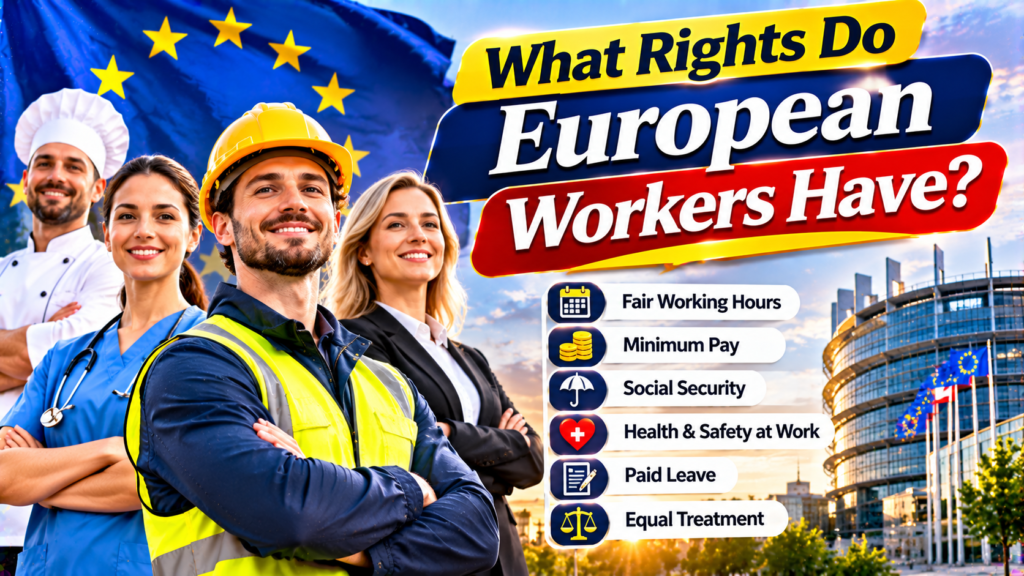
Some of the most important employment rights include:
- The right to fair and transparent working conditions.
- The right to receive agreed wages and employment benefits.
- The right to paid annual leave.
- The right to reasonable working hours and rest periods.
- The right to a safe and healthy workplace.
- The right to equal treatment and protection against discrimination.
- The right to maternity, paternity and parental leave under applicable national rules.
- The right to protection against unfair dismissal under relevant national law.
- The right to join trade unions and participate in collective bargaining.
- The right to privacy and protection of personal information.
These protections help create a balanced relationship between employers and employees. However, the precise entitlements and procedures depend on national legislation and, in some cases, collective bargaining agreements.
2. Do European Workers Have the Right to Fair Wages?
Yes, European workers have the right to receive the wages agreed under their employment contracts and applicable labour laws. Minimum wage protections also exist across many European countries.
However, there is no single universal minimum wage applicable to every EU member state. Countries determine their own minimum wage systems, taking into account economic conditions, living costs, labour market policies and collective bargaining arrangements.
Some countries establish statutory minimum wages, while others rely heavily on collective agreements between employers and trade unions.
Why is fair pay important for European workers?
Fair wages help employees meet everyday expenses, maintain financial stability and enjoy a reasonable standard of living. They also reduce workplace exploitation and promote economic equality.
Important wage-related protections include:
- Payment according to the employment contract.
- Compliance with applicable national minimum wage rules.
- Protection against unlawful wage deductions.
- Payment for overtime where required by national law or collective agreements.
- Transparent information about salary and payment conditions.
- Equal pay protections for women and men performing equal work or work of equal value.
Workers should carefully review their employment contracts and payslips to understand their salary, deductions, bonuses and other financial benefits.
3. How Many Working Hours Are European Workers Allowed to Work?
Working hours are another important area of European employment protection. The EU Working Time Directive establishes minimum standards concerning working time, rest periods and annual leave.
Under the directive, the average working week, including overtime, must not exceed 48 hours over the applicable reference period.
This does not mean every European worker must work exactly 48 hours per week. Many countries have shorter standard working weeks, and individual employment contracts may establish different arrangements.
European workers also receive important rest-period protections.
Key working-time rights include:
- A minimum daily rest period of 11 consecutive hours in each 24-hour period.
- A rest break when the working day exceeds six hours, with the details determined by national law or collective agreements.
- A minimum weekly rest period of 24 uninterrupted hours, in addition to the daily rest period, subject to applicable exceptions.
- An average maximum working week of 48 hours, including overtime.
- Special protections for night workers.
These rules aim to prevent excessive working hours, reduce fatigue and support employees’ physical and mental well-being.
Some sectors, including healthcare, transport and emergency services, may have special arrangements or exceptions under applicable rules.
4. Do European Workers Have the Right to Paid Annual Leave?
Yes. Paid annual leave is one of the most important employment rights protected under EU law.
Under the EU Working Time Directive, workers are entitled to at least four weeks of paid annual leave every year. Individual countries may provide more generous holiday allowances.
For example, some European countries offer additional statutory holidays or benefits through collective agreements and employment contracts.
Why is paid leave important?
Employees need time away from work to rest, spend time with family, travel and recover from professional responsibilities. Paid annual leave also supports work-life balance and helps prevent burnout.
Common leave-related entitlements include:
- At least four weeks of paid annual leave under EU minimum standards.
- Public holidays according to national legislation.
- Additional contractual holiday allowances where applicable.
- Rules governing the transfer or payment of unused leave in certain circumstances.
Employers generally cannot replace the minimum annual leave entitlement with a financial payment, except when employment ends and unused accrued leave must be compensated.
5. What Rights Do European Workers Have Against Workplace Discrimination?
Equal treatment is a fundamental principle of European employment law. Workers should be treated fairly regardless of characteristics protected by applicable anti-discrimination legislation.
EU law prohibits discrimination in employment on several grounds, including:
- Sex.
- Racial or ethnic origin.
- Religion or belief.
- Disability.
- Age.
- Sexual orientation.
European legislation also provides protections against discrimination based on sex in areas such as recruitment, promotion, pay and working conditions.
Why does workplace equality matter?
Discrimination can prevent talented individuals from accessing employment opportunities, receiving fair compensation or progressing in their careers. Equal treatment helps build inclusive workplaces where employees are evaluated according to their abilities, experience and performance.
Examples of discriminatory workplace practices may include:
- Rejecting qualified candidates because of their ethnic background.
- Paying employees differently because of their sex for equal work or work of equal value.
- Denying promotion opportunities because of age.
- Treating employees unfairly because of a disability.
- Harassing workers because of their religion or sexual orientation.
Workers who experience discrimination can seek assistance through national equality bodies, labour authorities, trade unions or legal professionals.
6. What Maternity, Paternity and Parental Leave Rights Do European Workers Have?
European employment laws recognise the importance of supporting employees during pregnancy, childbirth and parenthood. Working parents are entitled to several protections designed to help them balance professional responsibilities with family life.
The EU Work-Life Balance Directive establishes minimum standards for parental and family-related leave, although individual countries can offer more generous benefits.
What are the main family-related employment rights?
Maternity leave: Pregnant employees are entitled to at least 14 weeks of maternity leave under EU legislation, including at least two weeks of compulsory maternity leave, before or after childbirth as determined by national law.
Paternity leave: Fathers and equivalent second parents are entitled to at least 10 working days of paternity leave around the birth of a child. Compensation must be at least equivalent to the level of sick pay under the directive.
Parental leave: Each parent has an individual entitlement to at least four months of parental leave. At least two months are non-transferable and must be adequately paid or compensated at a level determined by national law.
Carers’ leave: Employees are entitled to at least five working days of carers’ leave per year to provide personal care or support to relatives or household members with serious medical needs, subject to national implementation.
Other important protections include:
- Protection against dismissal because of pregnancy or taking qualifying family leave.
- The right to request flexible working arrangements for parents of children up to a specified age of at least eight years.
- Protection against unfavourable treatment for exercising family-related employment rights.
- Employment protections when returning from maternity or parental leave.
These measures help European families manage childcare responsibilities without unnecessarily sacrificing their careers.
7. Do European Workers Have the Right to a Safe and Healthy Workplace?
Yes. Workplace health and safety are fundamental employment rights throughout the European Union.
Employers have a legal responsibility to assess workplace risks and take appropriate measures to protect employees from accidents, occupational diseases and dangerous working conditions.
The EU Framework Directive on Occupational Safety and Health establishes general principles for protecting workers.
What does workplace safety protection include?
- Safe working equipment and machinery.
- Proper ventilation and suitable workplace conditions.
- Protection against harmful chemicals and hazardous substances.
- Appropriate training about workplace risks.
- Safety procedures for dangerous activities.
- Preventive measures against workplace accidents.
- Protection against occupational illnesses.
- Appropriate protective clothing and equipment where necessary.
For example, construction companies must take precautions against falls, machinery accidents and exposure to hazardous materials. Healthcare employers must protect employees from biological risks and workplace injuries.
Workers also have responsibilities. They should follow safety instructions, use protective equipment and report dangerous conditions.
Can employees refuse dangerous work?
Under applicable national laws implementing EU safety legislation, workers should be protected when facing serious and imminent danger. Employers must provide appropriate safeguards, and employees should not be penalised for taking protective action in accordance with the law.
Workplace safety is not simply an employer responsibility; it requires cooperation between management, employees and safety representatives.
8. What Protection Do European Workers Have Against Unfair Dismissal?
Can an employer dismiss an employee without giving a valid reason? The answer depends on the country’s employment legislation and the circumstances of the dismissal.
European countries have different rules governing termination of employment. However, workers benefit from several protections against unlawful or discriminatory dismissal.
In many European countries, employers must follow specific procedures before terminating employment.
These may include:
- Providing a valid reason for dismissal where required by national law.
- Giving the employee the required notice period.
- Following consultation procedures in applicable situations.
- Paying outstanding wages and other contractual entitlements.
- Providing compensation where legally required.
- Respecting protections against discrimination and retaliation.
- Following special procedures for collective redundancies.
For example, an employer cannot lawfully dismiss someone simply because they exercised protected rights, such as reporting discrimination or requesting legally protected family leave.
What happens if a worker believes a dismissal is unfair?
The employee may be able to challenge the decision through an employment tribunal, labour court or another competent national authority.
Depending on national legislation, possible remedies may include reinstatement, financial compensation or other legal relief.
Workers should keep copies of employment contracts, dismissal letters, emails, payslips and other relevant documents when challenging an employment decision.
9. Do European Workers Have the Right to Join Trade Unions?
Yes. Freedom of association and the right to organise are important features of European employment systems.
Workers generally have the right to establish or join trade unions to represent their professional interests. They can also participate in collective bargaining under the applicable national legal framework.
What do trade unions do for European employees?
Trade unions represent workers in discussions with employers and help negotiate better employment conditions.
Their activities may include:
- Negotiating wages and salary increases.
- Supporting fair working hours.
- Improving workplace safety.
- Protecting employees against unfair treatment.
- Negotiating additional holiday benefits.
- Representing workers in employment disputes.
- Supporting collective action where legally permitted.
Collective bargaining plays a significant role in several European countries. In some industries, collective agreements establish employment conditions that are more favourable than the statutory minimum standards.
For example, workers in manufacturing, transportation, healthcare and hospitality may benefit from sector-specific agreements covering wages, overtime, working schedules and additional benefits.
Trade unions also help employees understand their rights and access professional representation when workplace disputes arise.
10. What Rights Do Part-Time and Temporary Workers Have in Europe?
Are part-time employees entitled to the same basic protections as full-time employees? Yes, EU legislation provides important safeguards against unfair treatment based solely on working arrangements.
The Part-Time Work Directive promotes equal treatment for part-time employees, while the Fixed-Term Work Directive protects workers employed under fixed-duration contracts.
These protections are important because modern European workplaces include different forms of employment.
Part-time workers generally benefit from:
- Protection against unjustified less favourable treatment compared with comparable full-time workers.
- Access to employment benefits on a pro-rata basis where appropriate.
- Protection under applicable minimum wage rules.
- Working-time and health-and-safety protections.
- Access to training and professional development opportunities.
Temporary and fixed-term employees also receive important protections.
Employers should not treat workers less favourably simply because they have a fixed-term contract rather than a permanent employment agreement, unless objective reasons justify different treatment.
Temporary agency workers have additional protections under EU legislation, including the principle of equal treatment regarding certain basic working and employment conditions.
These rules help prevent employers from using non-permanent employment arrangements to avoid their legal responsibilities.
11. Do European Workers Have Rights When Working Remotely?
Remote and hybrid working have become increasingly important across Europe. Many employees now work from home, shared offices or different locations instead of attending a traditional workplace every day.
However, does working remotely mean employees lose their employment rights?
No. Remote workers generally retain their applicable employment protections, including rights relating to pay, working time, health and safety, privacy and equal treatment.
Depending on national law and employment agreements, remote workers may also benefit from:
- Clear written agreements about remote working arrangements.
- Appropriate working equipment.
- Protection of personal information.
- Workplace health and safety assessments.
- Rules concerning working hours and overtime.
- Reasonable arrangements for communication with employers.
- Access to training and career development.
What is the right to disconnect?
The right to disconnect refers to the ability of employees to avoid work-related communications outside their agreed working hours without facing negative consequences.
There is no single comprehensive EU-wide statutory right to disconnect that applies identically to all workers. However, several European countries have introduced national laws, policies or collective agreements addressing this issue.
Remote employees should understand their country’s rules and their organisation’s policies concerning availability, overtime and after-hours communication.
12. What Privacy Rights Do European Workers Have at Work?
Can employers monitor employees’ emails, internet activity or workplace communications?
Employers may monitor certain workplace activities for legitimate business purposes, but they must respect applicable privacy and data protection laws.
The General Data Protection Regulation (GDPR) provides important protection for employees’ personal information throughout the EU.
Employers must have a lawful basis for processing personal data and follow principles such as transparency, purpose limitation and data minimisation.
What privacy protections can employees expect?
- Clear information about how personal data is collected and used.
- Protection against unnecessary collection of personal information.
- Appropriate security measures for employee records.
- Access to personal information in accordance with GDPR.
- The right to request correction of inaccurate personal information.
- Protection against unlawful disclosure of sensitive information.
- Appropriate safeguards when monitoring workplace activities.
For example, an employer may have legitimate reasons to monitor company equipment for security purposes. However, monitoring should be proportionate and legally justified.
Employees should receive appropriate information about workplace monitoring and how their personal information is processed.
13. What Rights Do European Workers Have Regarding Training and Career Development?
Professional development is increasingly important in Europe’s changing labour market.
Workers need opportunities to improve their skills, learn new technologies and adapt to changing industry requirements.
EU legislation supports access to employment-related training and professional development, although the exact entitlements vary across countries and workplaces.
Under the Transparent and Predictable Working Conditions Directive, workers are entitled to receive certain mandatory training free of cost when the employer is required by EU, national law or collective agreements to provide it.
Other career development opportunities may include:
- Employer-sponsored training programmes.
- Workplace skill development.
- Apprenticeship opportunities.
- Professional certification.
- Digital skills training.
- Vocational education.
- Career advancement programmes.
Why is professional training important?
It helps workers remain competitive, improves productivity and creates opportunities for career progression.
European employers also benefit from a skilled workforce that can adapt to technological developments and changing business requirements.
14. Do Migrant and Foreign Workers Have the Same Employment Rights in Europe?
Europe attracts millions of international workers seeking better career opportunities, professional development and improved living standards.
But do foreign employees enjoy the same workplace protections as local workers?
In many situations, yes. EU law provides important protections against discrimination and unfair treatment, while national employment legislation determines many specific entitlements.
Workers from EU member countries also benefit from EU rules on free movement, allowing them to work in other member states subject to applicable conditions.
Foreign workers may have rights relating to:
- Payment of legally required wages.
- Safe and healthy working conditions.
- Protection against workplace discrimination.
- Appropriate working hours and rest periods.
- Paid annual leave.
- Employment contracts and transparent working conditions.
- Access to applicable social security benefits.
- Legal remedies against unlawful employment practices.
However, immigration and employment rights are not identical. Non-EU nationals may need appropriate visas or work permits, and their access to certain benefits may depend on their immigration status and national legislation.
Employers must also comply with applicable rules concerning migrant workers, recruitment conditions and employment documentation.
International employees should understand both their employment rights and the immigration requirements of the country where they intend to work.
15. What Rights Do Gig Economy and Platform Workers Have in Europe?
The growth of digital platforms has transformed employment opportunities across Europe. Food delivery drivers, ride-hailing drivers, freelance service providers and other platform workers are now part of the modern labour market.
But do gig economy workers enjoy the same rights as traditional employees?
Their legal protections depend significantly on their actual employment status and national legislation.
The EU Platform Work Directive (EU) 2024/2831 aims to improve working conditions for people performing platform work.
It addresses important issues such as employment status, algorithmic management and transparency in automated workplace decisions.
Important areas of protection include:
- Better procedures for determining whether an employment relationship exists.
- Greater transparency about automated monitoring and decision-making.
- Human oversight of certain important automated decisions.
- Protection of personal data.
- Improved access to information about working conditions.
- Safeguards against certain unfair automated employment decisions.
The directive entered into force in December 2024, and EU member states have until 2 December 2026 to transpose it into national law.
These developments are particularly important as digital platforms become increasingly influential in Europe’s employment market.
16. What Social Security Benefits Can European Workers Receive?
Social security is another important part of employment protection across Europe.
Depending on national legislation, employment status and contribution history, workers may qualify for different benefits designed to provide financial assistance during difficult circumstances.
Common social security benefits include:
- Healthcare coverage.
- Sickness benefits.
- Maternity and paternity-related benefits.
- Unemployment benefits.
- Pension benefits.
- Disability support.
- Family allowances.
- Occupational injury compensation.
Are these benefits identical throughout Europe?
No. Each country has its own social security system, eligibility requirements, contribution rules and payment arrangements.
However, EU social security coordination rules help people who move between EU countries. These rules coordinate national systems and help protect certain social security entitlements when individuals work or live in more than one member state.
For example, an employee who moves from one EU country to another may be able to have relevant insurance periods taken into account when determining eligibility for certain benefits.
This coordination is particularly important for international professionals, cross-border employees and people who spend different stages of their careers in different European countries.
17. How Can European Workers Protect Their Employment Rights?
Knowing employment rights is important, but employees must also understand how to exercise them when problems arise.
Workers who experience unpaid wages, discrimination, unsafe working conditions or unfair employment practices should take appropriate steps to protect their interests.
What practical steps can employees follow?
1. Understand the employment contract
Employees should carefully review their contracts before accepting employment. Important details include salary, working hours, leave entitlements, probationary periods, notice requirements and job responsibilities.
2. Keep employment records
Workers should maintain copies of important documents, including:
- Employment contracts.
- Payslips and salary statements.
- Work schedules.
- Leave records.
- Relevant workplace emails.
- Performance reviews.
- Written communication about workplace complaints.
3. Raise concerns with the employer
Employees can initially contact their manager, human resources department or designated workplace representative to discuss employment-related problems.
4. Contact a trade union
Trade unions can provide advice, representation and support during workplace disputes.
5. Approach labour authorities
National labour inspectorates and employment authorities can investigate certain employment violations and provide information about applicable legal protections.
6. Seek legal advice
For serious disputes involving dismissal, discrimination, unpaid wages or workplace injuries, consulting an employment lawyer may help employees understand their options.
Workers should remember that complaint procedures and legal deadlines differ between European countries.
18. Are Employment Rights the Same in Every European Country?
No. This is one of the most important points to understand about European employment law.
The European Union establishes minimum employment standards in several areas, but member countries implement these protections through their own national legislation.
As a result, workers may receive different benefits depending on where they are employed.
For example:
- Minimum wages differ between EU countries.
- Annual holiday allowances may exceed the EU minimum.
- Maternity and parental leave payments vary.
- Notice periods depend on national employment laws.
- Dismissal procedures differ.
- Collective bargaining agreements may provide additional benefits.
- Social security contributions and entitlements vary.
It is also important to distinguish between the European Union and geographical Europe. Countries such as the United Kingdom, Switzerland and Norway are not EU members and have their own employment frameworks, although some European countries outside the EU participate in certain European labour or social protection arrangements.
Therefore, workers should always check the employment legislation applicable to their specific country rather than assuming that every European nation follows identical rules.
Frequently Asked Questions About European Workers’ Rights
Q1. What are the most important rights of European workers?
Ans: The most important rights include fair employment conditions, paid annual leave, reasonable working hours, workplace safety, protection against discrimination, transparent employment contracts and access to applicable social security benefits.
Q2. Are European workers entitled to paid holidays?
Ans: Yes. Workers covered by the EU Working Time Directive are entitled to at least four weeks of paid annual leave. Individual countries may provide additional holidays.
Q3. Can European employers make employees work more than 48 hours per week?
Ans: The EU Working Time Directive sets an average maximum working week of 48 hours, including overtime, over the applicable reference period. Certain sectors and activities may have specific exceptions.
Q4. Can an employer dismiss a worker without notice in Europe?
Ans: This depends on national employment law and the circumstances. Some situations allow immediate dismissal, while others require notice, a valid reason or specific procedures.
Q5. Do European workers have the right to join trade unions?
Ans: Yes. Freedom of association and the right to organise are protected principles. Employees can generally join trade unions and participate in collective bargaining subject to applicable national laws.
Q6. Are foreign workers protected by European employment laws?
Ans: Foreign workers benefit from important employment protections, including applicable wage, safety and anti-discrimination rules. Their specific entitlements may depend on their employment status, immigration status and national legislation.
Q7. Do European workers receive maternity and paternity leave?
Ans: Yes. EU legislation establishes minimum maternity and paternity leave entitlements, while national governments determine payment arrangements and may offer more generous benefits.
Q8. What should workers do if their employer violates employment laws?
Ans: They can raise the issue with their employer, contact a trade union, approach the national labour inspectorate or seek assistance from an employment lawyer.
Q9. Do part-time workers have the same rights as full-time employees?
Ans: Part-time workers are protected against unjustified less favourable treatment under EU law. Certain benefits may be calculated proportionately according to working hours.
Q10. Are European workers protected when working from home?
Ans: Yes. Remote workers generally retain their employment rights, including protections concerning working hours, health and safety, privacy and equal treatment.
Conclusion: Why Are Employment Rights Important for European Workers?
What rights do European workers have? They have access to a wide range of employment protections designed to promote fairness, safety, equality and financial security.
From fair wages and paid holidays to workplace safety, family leave, social security and protection against discrimination, employment laws play a significant role in shaping Europe’s working environment.
However, understanding these rights requires recognising the difference between EU-wide minimum standards and individual national employment laws. Not every European country offers identical salaries, benefits or workplace protections.
As technology, remote working, artificial intelligence and digital employment platforms continue to transform the labour market, protecting workers’ interests will remain an important priority.
Ultimately, employment rights are not just legal requirements. They help create workplaces where people can work with dignity, build successful careers and maintain a healthy balance between professional and personal life.
For European workers, understanding employment rights is an important step towards achieving greater workplace security, equality and long-term career development.
Read More – Changing Europe Housing Landscape